What is structured idea evaluation? A 2026 guide for SMBs
Structured idea evaluation is the disciplined process of turning employee ideas into clear decisions through agreed scoring criteria, named owners, mandatory feedback, and documented outcomes. SMBs often do not need heavy enterprise idea-management software, but they do need a lightweight system that prevents ideas from disappearing into spreadsheets, committees, or unanswered suggestion boxes.
By Dennis Jacobs
What is structured idea evaluation? A 2026 guide for SMBs
The term "structured idea evaluation" describes a process, not a product. It refers to how a company decides which employee-submitted ideas to pursue, on what criteria, with what kind of accountability for the decision, and with what kind of feedback back to the person who submitted the idea.
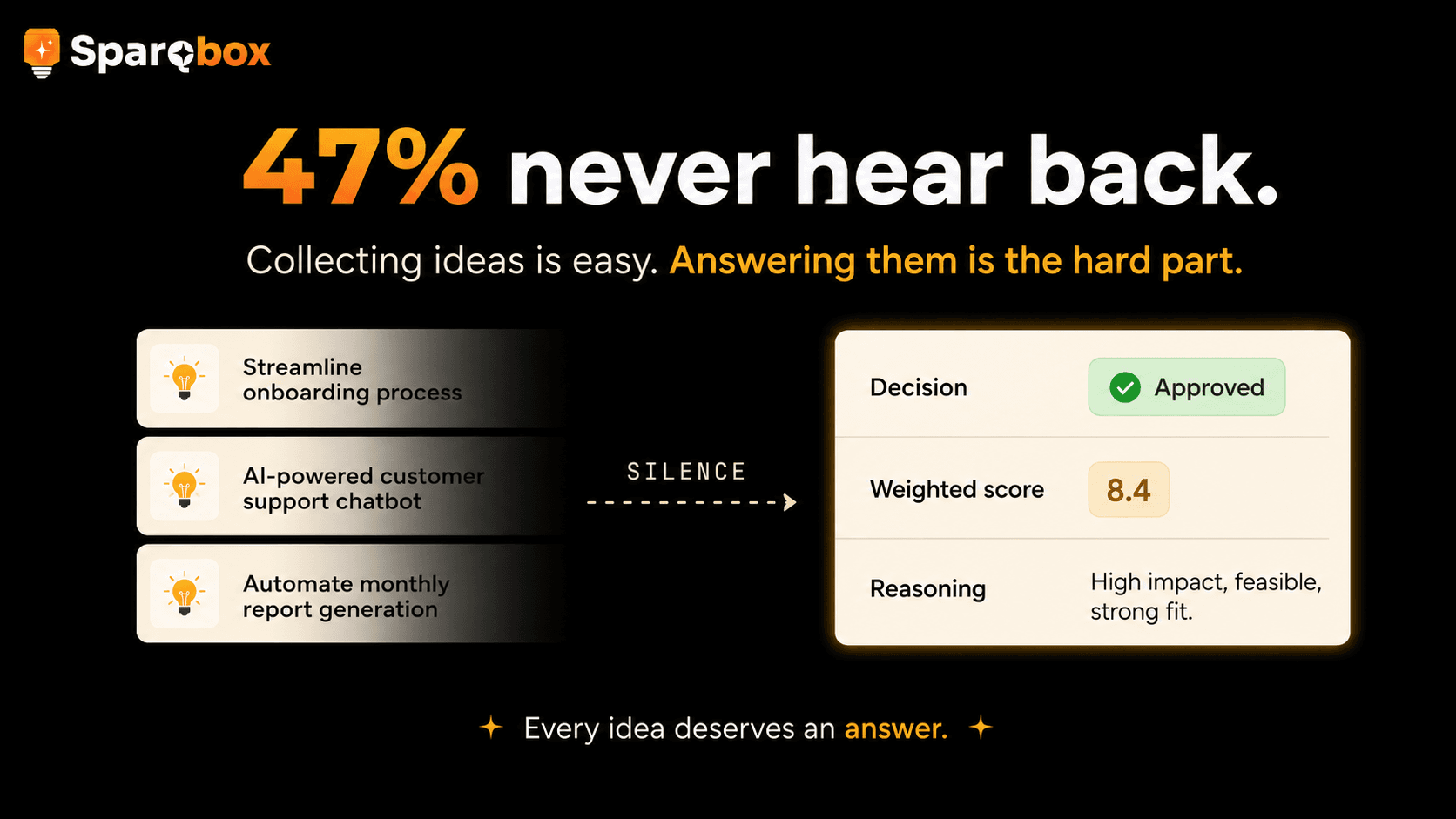
That definition is doing a lot of work, so it's worth unpacking. Most companies have some way to collect employee ideas. A suggestion box, a quarterly innovation event, an internal portal, a shared mailbox. Collecting ideas is easy. What separates a structured evaluation system from any of those is what happens after the idea is collected: whether there are criteria, whether a named person is accountable, whether decisions get documented, and whether the original submitter gets a response.
For most SMBs, those four conditions don't exist. Ideas pile up, decisions happen on gut feel or not at all, and employees eventually stop submitting. The cost is not the lost ideas. The cost is the lost trust.
This guide explains what structured idea evaluation actually consists of, how it differs from broader categories like idea management, and how SMBs in particular can implement it without buying enterprise software.
How is structured idea evaluation different from idea management?
Idea management is the vendor category. Brightidea, IdeaScale, Spigit, and a dozen others sell themselves under this label. They tend to be feature-rich platforms designed for organizations with formal innovation functions, multi-stage stage-gate processes, and dedicated governance.
Structured idea evaluation is narrower. It's the subset of idea management that actually moves ideas to decisions. Many idea management platforms are excellent at collection and discussion, and weak at the part that matters: someone reading the idea, scoring it against agreed criteria, deciding yes or no, and telling the submitter what happened.
A useful comparison:
| Suggestion box | Idea management platform | Structured idea evaluation | |
|---|---|---|---|
| Idea submission | Yes | Yes | Yes |
| Voting / discussion | No | Yes | Optional |
| Scoring against criteria | No | Sometimes | Always |
| Named decision owner | No | Sometimes | Always |
| Mandatory feedback to submitter | No | Rarely | Always |
| Designed for SMBs | No | Rarely | Yes |
The distinction matters because companies that buy idea management software often get the collection part working and never finish the rest. The structured evaluation framing names the parts that usually go missing.
Why SMBs need this differently than enterprises
Large enterprises have innovation functions. A team of full-time people whose job is to source, score, prioritize, and report on innovation pipelines. They have governance committees, stage gates, executive sponsors, quarterly portfolio reviews. The problem at scale is coordination, not absence.
SMBs in the 50-500 employee range don't have any of that. They have an operations leader who cares, an HR director who supports it, and maybe one motivated middle manager running an unofficial program in a spreadsheet. The problem at this scale is the opposite: there's nobody whose job it is to make this work, so it doesn't.
That's why structured idea evaluation looks different for SMBs:
- It needs to work without a dedicated team.
- It needs to be configurable in an afternoon, not over a six-month implementation.
- It needs to enforce the discipline (named owners, mandatory feedback) that wouldn't happen otherwise.
- It needs to be cheap enough that one operations lead can champion it without a budget fight.
Enterprise idea management software exists for the first kind of company. It does not work for the second kind, regardless of how it's marketed.
The five components of a structured evaluation system
A structured evaluation system has five components. Each is necessary. None is sufficient on its own.
1. A submission framework that captures the right things upfront.
Most idea submission forms ask only for a title and description. The result is a backlog of ideas you can't compare because they're describing different things at different levels of detail.
A useful submission form captures, at minimum: a clear title, a description of the proposed change, the problem it solves, the expected impact, and the category it belongs to. Optional but useful: the submitter's estimate of effort, links to evidence, and whether they want to remain anonymous.
The discipline of structured fields does two things. It forces the submitter to think before submitting, which improves average quality. And it makes the evaluation tractable, because every idea is now comparable on the same dimensions.
2. Scoring criteria your team agreed on before the ideas came in.
This is the most important component and the one most companies skip. The criteria need to exist before the ideas, not after, because criteria established in response to specific ideas are post-hoc rationalization, not evaluation.
Useful criteria depend on the category. A cost-reduction idea is evaluated differently than a customer-experience idea. But within a category, every idea is scored against the same set of weighted criteria. Five or six criteria per category is enough. Weights should sum to 1.0 and be agreed on by the people doing the scoring.
The output is a weighted score per idea. The weighted score does not make the decision. It informs the decision-maker, who still has to read the idea, consider context the criteria don't capture, and apply judgment.
3. A named owner per category.
A committee meeting once a month creates a 30-day decision cycle minimum. Most ideas die of attrition before they reach a vote. The companies that actually decide things have named owners: one person per category who is accountable for moving ideas through the pipeline and making the call.
The named owner doesn't have to do all the work. They can route reviews to subject-matter experts, defer to subcommittees on hard cases, and consult their manager on high-stakes decisions. What they cannot do is hide behind a committee. The accountability sits with a person, not a process.
4. A mandatory feedback loop to the submitter.
Every idea gets a written response. No exceptions. Approve, decline, or defer. With reasoning.
This is the single most predictive component of a healthy program. Companies that respond consistently keep submission rates steady for years. Companies that don't see submission rates collapse within 18 months, regardless of how generous the incentives are. People don't submit for prizes. They submit to be heard. An idea without a response teaches them they aren't.
5. Decision tracking that lasts beyond the moment.
Decisions get documented somewhere durable. Not in the head of the operations lead, not in a Slack message, not in an Excel file that gets renamed every quarter. A persistent record of: this idea, this decision, on this date, by this person, for these reasons.
Two reasons this matters. First, it makes the system auditable when leadership asks where the ideas are going. Second, it makes the pattern of decisions visible over time, which is the only way to spot bias or systematic gaps.
Common failure modes
Three patterns repeat in companies that try to build this and fail.
The submission-volume obsession.
A company launches an idea program, markets it aggressively, gets a flood of submissions in the first eight weeks, and declares success based on volume. Twelve weeks later, the submissions have dropped by 60%. Eighteen weeks later they've stopped entirely.
The submission volume was never the success metric. The decision rate was. A program that collects 200 ideas and decides on 5 is failing more visibly than a program that collects 50 ideas and decides on 30. Volume is the easy metric. Decisions are the real one.
The committee trap.
A cross-functional committee is appointed to evaluate ideas. The committee meets monthly. Each meeting has 20 ideas on the agenda. The committee discusses three of them, defers the rest. Over six months, the backlog grows. After a year, the committee stops meeting.
Committees feel democratic. They're not. They're slow, risk-averse, and impossible to hold accountable. The companies that decide things have one person per category, not a committee.
The unanswered idea.
An employee submits an idea. It gets logged. It doesn't get reviewed. The employee never hears back. Six months later, in a one-on-one with their manager, they mention it. The manager says "yes, that was a good one, what ever happened to it?" The employee shrugs.
That employee submits no more ideas. They don't make a scene about it. They just stop. And they tell two colleagues why. Within a year, the program has lost its credibility with the operational staff who saw what happened.
What to look for in a tool (vendor-neutral)
If you're evaluating tools to support structured idea evaluation, the questions worth asking:
- Does it support per-category scoring criteria with weighted scoring?
- Can you assign a named owner per category, or is it committee-only?
- Does it enforce a feedback loop to the submitter, or is it optional?
- How does it handle anonymity?
- Where does it host data, and is it GDPR-compliant by default for European customers?
- What's the implementation time? If it's measured in months, it's enterprise software and you may be in the wrong tool category for an SMB.
- Pricing: per-user, per-employee, or flat? Per-employee pricing is the only honest model for SMBs because it doesn't punish you for inviting everyone.
When you don't need a tool
If your company is under 30 employees, you have one decision-maker, and you receive maybe two or three ideas per month, you do not need software. A simple shared document with categories, criteria, scores, decisions, and dates will work fine. The structure matters more than the tool.
The honest threshold for needing software is roughly: 50+ employees, more than five ideas per month, more than one person involved in scoring, and any need for distributed-team participation (multiple sites, remote workers). Below that, a well-maintained spreadsheet is genuinely sufficient.
Above that threshold, the spreadsheet starts to break for predictable reasons: scoring inconsistency across reviewers, lost responses to submitters, no audit trail, version-control problems. The cost of those failures usually exceeds the cost of basic software within the first year.
Putting it together
Structured idea evaluation is a process problem disguised as a software problem. The software helps, but the process discipline matters more. Five components, named owners, mandatory feedback, decisions that get documented. None of it is complex. All of it is rare.
If you're building this in-house, start with the criteria. Get the scoring framework agreed on before the first idea is submitted. If you don't, every decision afterwards becomes a debate about process rather than substance.
If you're buying software, look for tools that enforce the discipline, not just enable it. The difference matters more than any feature comparison.
Sparqbox is a structured idea evaluation platform for SMBs in the 50-500 employee range. We built it because we couldn't find an existing tool that worked for companies that size. Whether or not you choose us, the framework above is the framework that works.
Every idea deserves an answer.