Field notes from inside Sparqbox.
Articles on idea evaluation, weighted scoring, the academic research behind the product, and what we're learning from early customers.
Editor's picks

AI as first reviewer: why the human still decides
AI can make idea evaluation faster by scoring submissions, surfacing risks, detecting overlap, and drafting review notes, but it should never become the final decision-maker. In Sparqbox, AI acts only as a first reviewer: humans own the final score, status change, routing, and feedback to the submitter, with every decision remaining auditable and accountable. This human-in-the-loop architecture protects trust, reduces governance risk, and ensures AI improves the process without replacing human judgment.

What 50 companies taught me about idea selection
This blog explains that Dennis’ TU/e benchmark of 50 companies found that strong idea selection does not start with financial models or technical feasibility, because those numbers are usually unreliable in the early stage. The best-performing companies used strategic buckets, weighted scoring, customer acceptance, strategic fit, and one clear process owner instead of letting ideas drift into committees or management meetings. The main lesson: innovation programs work when every idea has a clear route, fair criteria, a named owner, and a guaranteed response, which is the research foundation behind Sparqbox.
12 posts

A clear no beats a polite silence in your suggestion box
Employees can live with a reasoned rejection. What they cannot live with is silence. Here is why a real no keeps people submitting, and how mandatory feedback and scoring thresholds make it routine.

Employees distrust AI reading their ideas. Here is where the line sits
Engagement research keeps finding the same risk: trust drops when employees learn AI reads their input. The line that protects trust is simple. AI scores first. People decide.
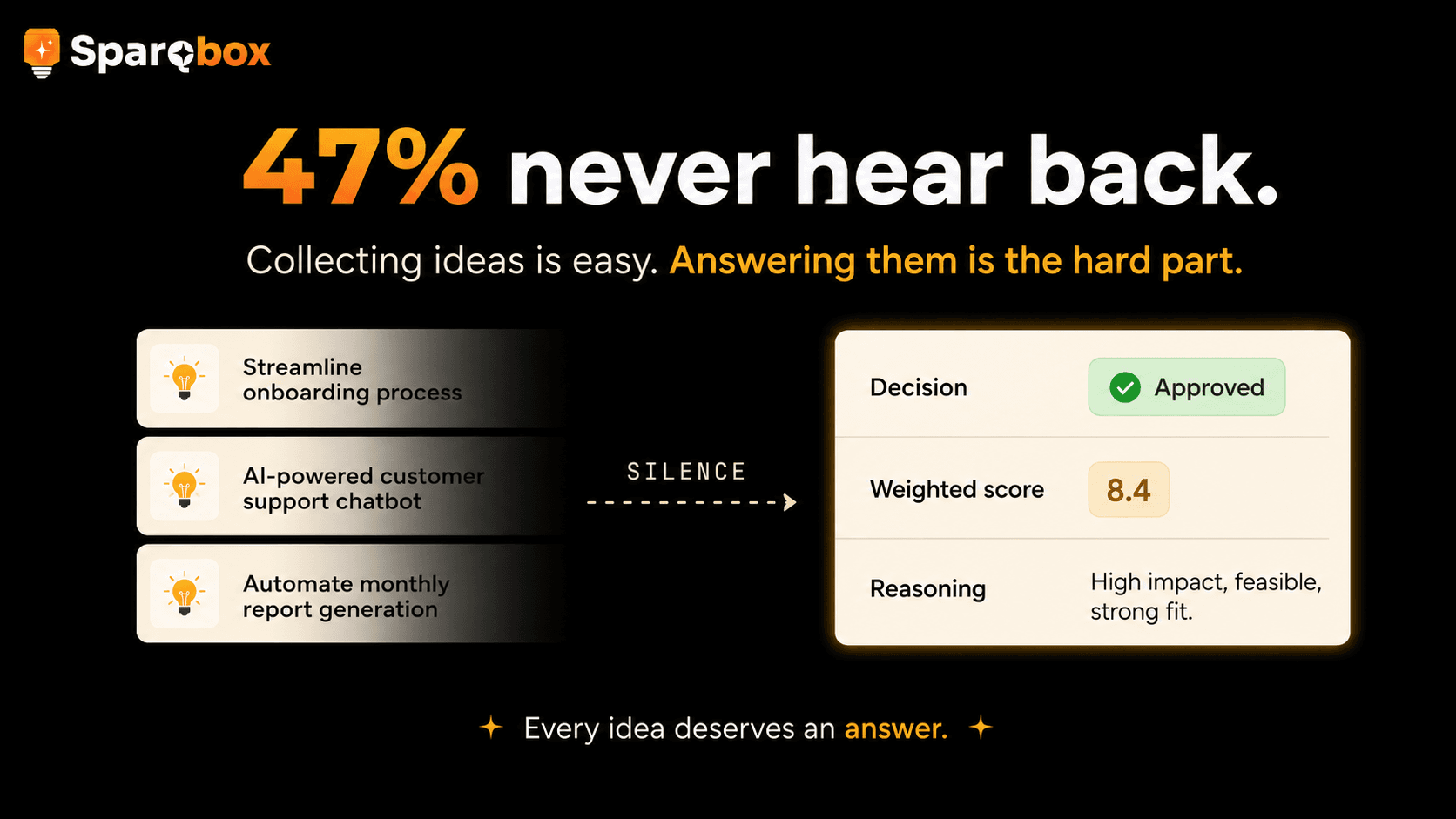
Why 47 percent of companies never close the feedback loop
Nearly half of companies collect employee ideas but only sometimes say what happened to them. The fix is not another suggestion box. It is a mandatory feedback loop where every idea gets a real answer.
AI as first reviewer: why the human still decides
AI can make idea evaluation faster by scoring submissions, surfacing risks, detecting overlap, and drafting review notes, but it should never become the final decision-maker. In Sparqbox, AI acts only as a first reviewer: humans own the final score, status change, routing, and feedback to the submitter, with every decision remaining auditable and accountable. This human-in-the-loop architecture protects trust, reduces governance risk, and ensures AI improves the process without replacing human judgment.

Idea management vs OKR vs project management: which one do you actually need
OKRs, idea management, and project management are not competing tools; they are three different layers in how a company decides what to work on. OKRs define the strategic targets, idea management evaluates which proposals are worth pursuing, and project management executes the approved work. Most mid-sized companies already have strategy and execution covered, but the missing middle layer causes prioritization to become political, informal, and disconnected from strategy.

Why your suggestion box is empty (and what to do about it)
An empty suggestion box does not mean employees have no ideas; it usually means they learned that submitting ideas is not worth their time. Employees stop contributing when they receive no answer, the submission process takes too much effort, submitting feels politically risky, or past contributors were never visibly acknowledged. The fix is not prizes or culture campaigns, but a disciplined process: close the loop on existing ideas, make submission easy, and make outcomes visible.
What 50 companies taught me about idea selection
This blog explains that Dennis’ TU/e benchmark of 50 companies found that strong idea selection does not start with financial models or technical feasibility, because those numbers are usually unreliable in the early stage. The best-performing companies used strategic buckets, weighted scoring, customer acceptance, strategic fit, and one clear process owner instead of letting ideas drift into committees or management meetings. The main lesson: innovation programs work when every idea has a clear route, fair criteria, a named owner, and a guaranteed response, which is the research foundation behind Sparqbox.
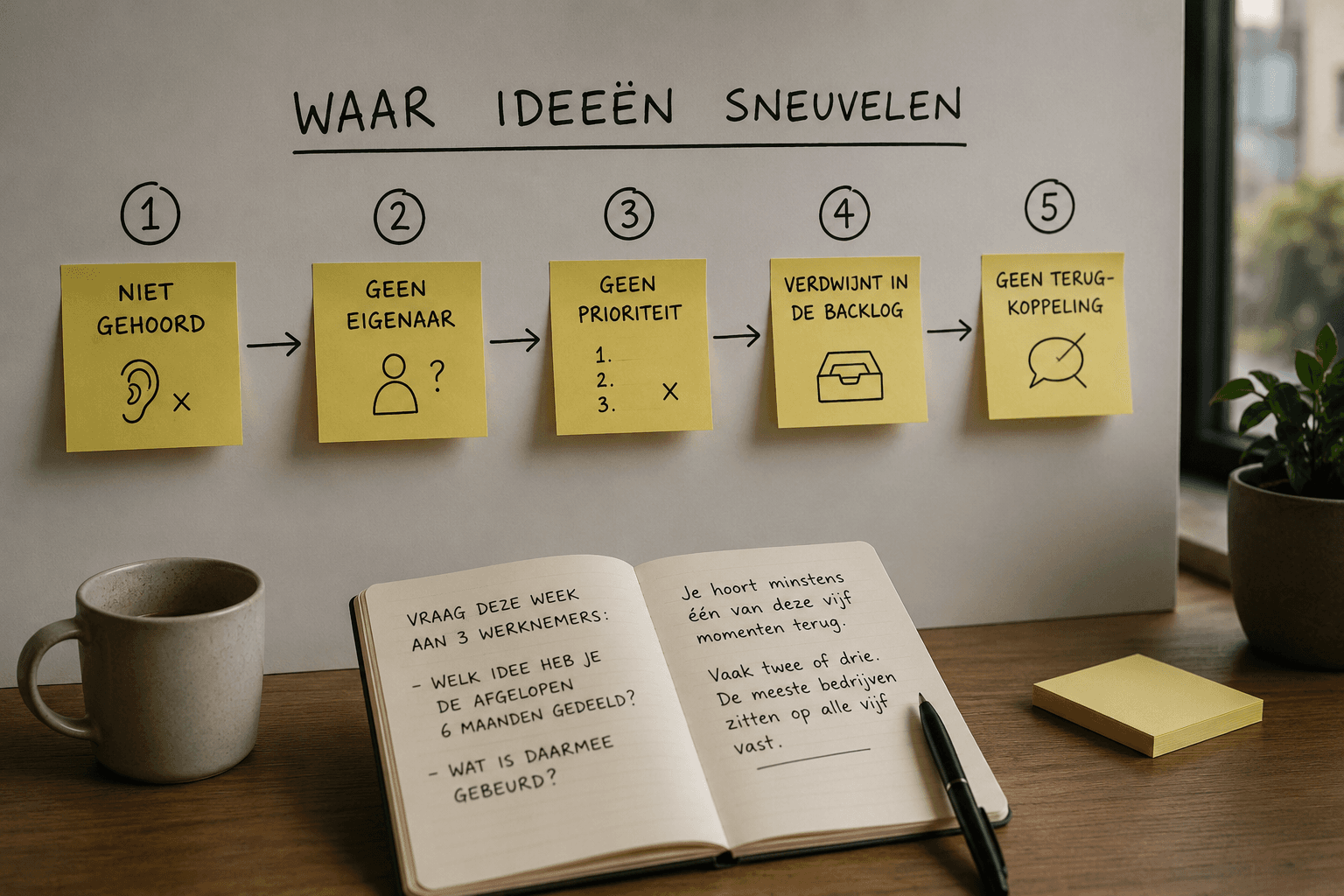
The five moments where ideas die in your company
Employee ideas don't die because people stop having them. They die at five specific moments inside the company (never being written down, landing in the wrong inbox, the 'interesting, I'll come back to that,' missing the leadership agenda, and being approved with no owner), and most companies have no process for any of them.

Why every employee idea deserves an answer (and what happens when they don't)
Every employee idea deserves a clear answer - approve, decline, or defer with reasoning - because silence teaches people that submitting ideas does not actually matter. Unanswered ideas quietly erode trust, reduce future submissions, and damage innovation culture, while a simple mandatory feedback loop with named owners can keep employees engaged and idea programs alive.

Sparqbox vs spreadsheets and email: when each one actually wins
Spreadsheets and email work well for very small idea programs, especially when there are few employees, few submissions, and one clear decision-maker. The blog argues that Sparqbox becomes the better option once ideas start getting lost, scoring becomes inconsistent, feedback is missed, reporting becomes painful, or the hidden time cost of managing the spreadsheet exceeds the software cost.

What is structured idea evaluation? A 2026 guide for SMBs
Structured idea evaluation is the disciplined process of turning employee ideas into clear decisions through agreed scoring criteria, named owners, mandatory feedback, and documented outcomes. SMBs often do not need heavy enterprise idea-management software, but they do need a lightweight system that prevents ideas from disappearing into spreadsheets, committees, or unanswered suggestion boxes.
Welcome to the Sparqbox blog!
A short note on what we'll write about, and why field notes from inside the product are more useful than another listicle.
Get new posts in your inbox.
Leave your email and we'll send a short note whenever a new post lands. No other emails, no marketing list. Unsubscribe with one click.
No spam. Just new posts. Unsubscribe any time.
Every idea deserves an answer.
Give your team the one thing a suggestion box never will: a real decision, every time.