Idea management vs OKR vs project management: which one do you actually need
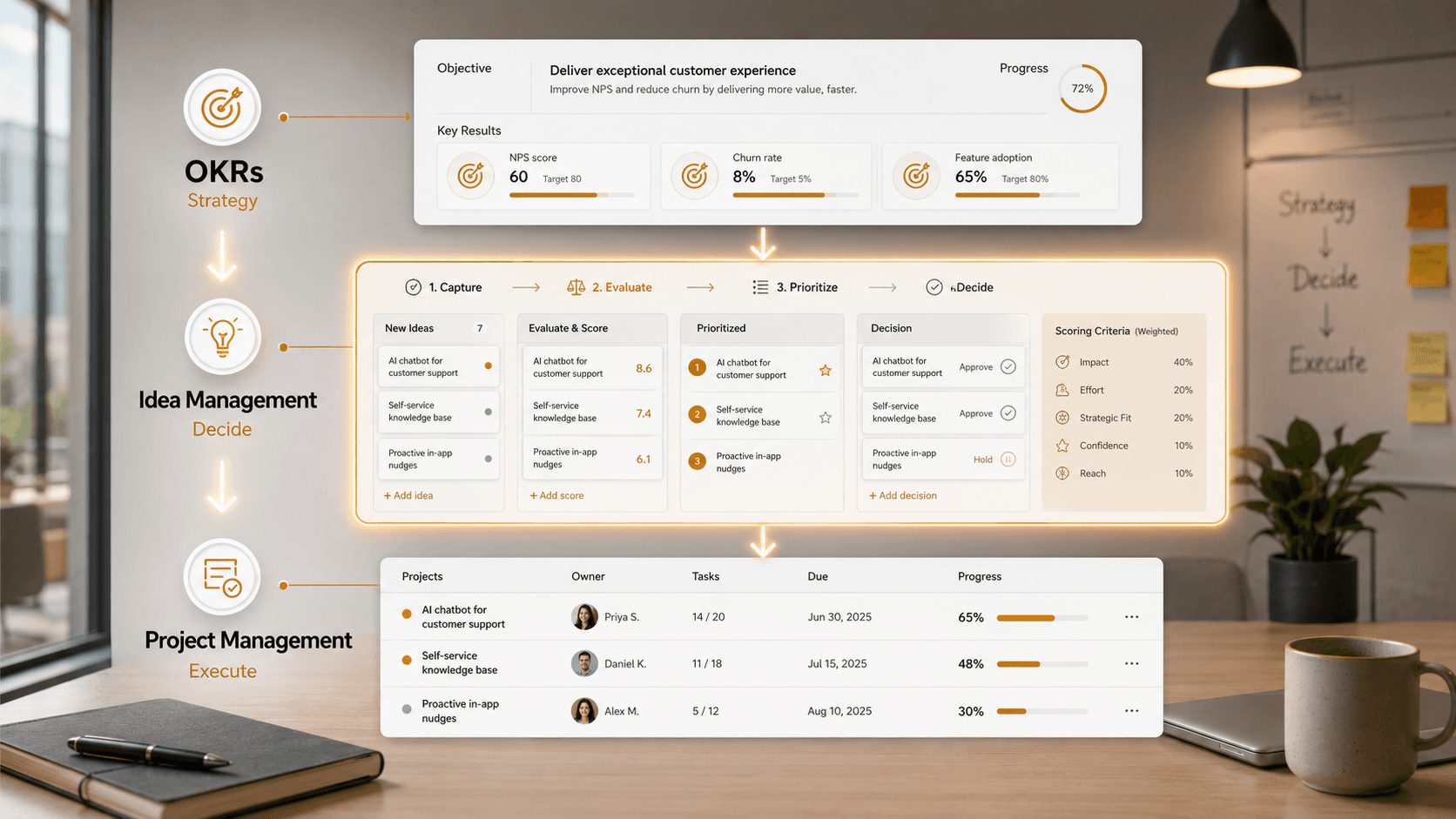
OKRs, idea management, and project management are not competing tools; they are three different layers in how a company decides what to work on. OKRs define the strategic targets, idea management evaluates which proposals are worth pursuing, and project management executes the approved work. Most mid-sized companies already have strategy and execution covered, but the missing middle layer causes prioritization to become political, informal, and disconnected from strategy.
By Dennis Jacobs
Idea management vs OKR vs project management: which one do you actually need
OKRs, idea management, and project management are not alternatives. They are three layers of how a company decides what to work on. OKRs set the strategic targets. Idea management surfaces and evaluates the proposals that could move those targets. Project management executes the proposals that get approved. Confusion between the three is what makes companies pick the wrong tool for the wrong layer, then conclude that none of them works.
Most companies in the 50 to 500 employee range have an OKR practice (or some version of strategic planning) and a project management practice (or some version of execution tracking). The layer in the middle, where decisions are made about which specific projects to invest in, is the one that is most often missing or improvised. This article walks through what each of the three layers actually does, where the middle layer fits in 2026, and how to tell which gap your company has.
The category confusion
Three things make this confusing. Each of the three categories overlaps with the others in the language used to describe it. Some software vendors claim to do all three, blurring the distinctions further. And the activities themselves shade into each other when a company is run informally, which is most companies.
OKR tools talk about "alignment" and "execution," which sounds like project management. Project management tools have "objectives" and "initiatives," which sounds like OKRs. Idea management tools have "projects" and "evaluation," which sounds like both. The vocabulary borrowing is real and the result is that buyers compare features that look similar without realizing the tools solve different problems.
The clearest way to cut through the overlap is to ask what decision each tool is built to support. OKRs answer "what should we aim at." Idea management answers "what should we actually do." Project management answers "how do we get it done." Three decisions, three tools, three points in the workflow. Mixing them produces friction.
What OKRs actually do
OKRs (Objectives and Key Results) set strategic direction. The objective is a qualitative statement of what the company is trying to achieve. The key results are the measurable outcomes that prove the objective is being met. A typical OKR is something like: Objective, become the preferred vendor for mid-market customers in our region; Key Results, sign 12 new mid-market accounts by Q4, achieve 80 percent customer retention, generate 15 mid-market case studies.
OKRs are top-down. They are typically set by leadership, cascaded to teams, and reviewed quarterly. The output of OKR practice is clarity about goals and a way to score progress toward them. OKR tools support this practice with structures for setting OKRs, tracking key result progress, aligning OKRs across teams, and reporting on overall achievement.
What OKRs do not do is decide which specific work will hit the targets. The OKR establishes that the team needs to sign 12 new mid-market accounts. It does not tell the team whether they should do that by improving the product, hiring three salespeople, running a content campaign, partnering with a channel, or all four. The conversion from goal to specific work happens somewhere else.
Most companies that adopt OKRs and then conclude they "do not work" have made a category error. The OKR practice is doing what OKRs do: providing direction. The thing not working is the next layer, the one that should be turning the direction into specific projects. Without that layer, the OKRs sit on the wall and the work goes on as it did before.
What project management actually does
Project management is execution. Once a project is approved, project management tracks the tasks, the dependencies, the owners, the deadlines, and the status. PM tools are built around the assumption that the project exists, is the right project to be doing, and has been resourced. The job is to deliver it.
The strongest PM tools are exceptional at this. Tasks broken down, owners assigned, status visible, blockers flagged, sprints planned. The discipline of execution is real, and the tools support it well.
What PM does not do is decide which projects should exist. PM is post-decision. It assumes someone has already chosen what to work on, prioritized it against other candidates, and committed resources. If that prior decision was wrong, PM will execute the wrong project efficiently, which is worse than not executing at all.
The failure mode for companies that lean on PM as a substitute for the layer above it is that the project pipeline gets filled by whoever can get a project approved, not by whoever has the best idea. The result is a project portfolio that looks busy and may even hit its deadlines, while the company is not actually working on the things that would move its targets. PM cannot detect this from the inside, because PM is not built to evaluate projects against alternatives. It is built to deliver the ones it has.
What idea management does
Idea management is the layer between strategy and execution. It surfaces candidate work from anyone in the organization (employees, customers, external signals, market events) and runs that work through a structured evaluation that ranks the candidates against the strategy. The output is a prioritized list of projects ready to enter the execution pipeline.
The evaluation has structure. Categories that map to strategic priorities. Weighted criteria that reflect what success looks like in each category. Scoring rubrics that produce comparable numbers across very different ideas. Feedback loops that ensure every submitted idea receives an answer. Coordinator assignments that ensure routing happens predictably.
The 50-company benchmark Dennis ran for his TU Eindhoven master's thesis on idea selection identified this middle layer as the variable that most strongly separated high-performing innovation programs from average ones. The companies with structured idea selection processes outperformed across nearly every measured success factor: alignment with strategic objectives, balance of project portfolio, time-to-decision, and the long-term resilience of the program itself.
Idea management is the discipline of treating "what should we work on" as a structured decision instead of an improvised one. It depends on the strategy layer above it to provide direction. It feeds the execution layer below it with prioritized work. Without it, the gap between strategy and execution is filled by whoever shouts loudest in meetings or by manager pet projects, which is the situation in most mid-sized companies today.
The three layers as a stack
Imagine the work-decision process as a vertical stack with three layers.
The top layer is strategic. OKRs (or any equivalent goal-setting practice) live here. The output is a set of quantified targets and a clear sense of what success looks like over the relevant time horizon.
The middle layer is decisional. Idea management lives here. The input is the strategic direction from the top layer. The output is a ranked list of specific projects that, if executed, would move the strategic targets. This is the layer where candidate work is collected, evaluated, prioritized, and approved.
The bottom layer is operational. Project management lives here. The input is the prioritized list of approved projects from the middle layer. The output is delivered work, measured by completion against scope and timeline.
Each layer feeds the next. The strategy informs the evaluation criteria at the middle layer. The middle layer feeds approved projects to PM. PM reports back on what was actually delivered, which becomes input to the next round of strategy.
The most common pattern in mid-sized companies is to operate the top and bottom layers explicitly while leaving the middle layer implicit. Leadership sets strategy. Teams use PM to execute. The decisions about which projects to do happen informally, in meetings, by whoever has the authority to say yes. The result is a portfolio that does not necessarily reflect the strategy, and that nobody can audit because the decisions were never structured.
When you need which
Five common situations and the diagnosis for each.
If your strategy is unclear and the company is busy but the work feels disconnected from goals, you have a strategy gap. The fix is OKRs or another structured approach to setting direction. Idea management and PM cannot compensate for the absence of strategic clarity, because both depend on knowing what success looks like.
If you have clear OKRs but the same projects keep getting prioritized regardless of whether they map to the OKRs, you have an idea management gap. The middle layer is missing or improvised, and the project pipeline reflects political weight rather than strategic value.
If you have clear OKRs and a structured evaluation process but the approved projects keep slipping or never finish, you have a PM gap. The execution layer is the constraint. Better PM tools and discipline can fix this without touching the layers above.
If submissions pile up but nothing gets decided, you have an idea management gap with a specific failure mode at the decision step. The capture is working. The evaluation is not. The fix is structured evaluation with named owners and a fixed cadence.
If projects get decided but the wrong people are deciding (loudest voice, most senior person, manager pet projects), you also have an idea management gap. The decision is happening, but not against structured criteria. The fix is to take the decision into a process where weighted scoring against named criteria replaces ad-hoc judgment.
Most companies in the 50 to 500 employee range have the strategy and execution layers operating with reasonable maturity and an absent or improvised middle layer. Sparqbox is the middle layer.
Why the three don't replace each other
The temptation, especially for buyers with limited budget, is to pick one tool and try to make it do the work of the others. This tends to fail in predictable ways.
Using an OKR tool as an idea management tool produces a strategic plan with too much detail, where individual project candidates get tracked as if they were OKRs themselves. The OKR cycle is too slow for project-level decisions (quarterly review is not the right cadence for evaluating new ideas) and the OKR vocabulary is not the right shape for what an idea evaluation actually needs.
Using a PM tool as an idea management tool produces a pipeline of "projects" that have not yet been evaluated, alongside projects that have been. The PM tool treats both the same, which means the evaluation discipline never happens. Ideas that should have been rejected get planned, staffed, and executed before anyone realizes the company chose to do the wrong project well.
Using an idea management tool as a PM tool fails the other way. Idea management tools are not built for sprint planning, task dependencies, or daily execution work. Trying to run a delivery team out of one produces friction and missing features.
The three categories exist because the underlying decisions are different. Each tool is shaped to the decision it supports. Forcing one to do another's job is more expensive than running all three, both in software cost and in the lost value of decisions made in the wrong vocabulary.
Common questions
What is the difference between idea management and project management?
Idea management decides which projects to do. Project management executes the projects that get approved. Idea management is pre-decision. Project management is post-decision. The two tools serve different points in the workflow and use different vocabulary (categories and weighted criteria for idea management; tasks, sprints, and dependencies for project management).
Do I need idea management software if I already use OKRs?
Yes, if you have a gap between your strategic OKRs and the specific projects in your execution pipeline. OKRs set the targets. They do not decide which specific work will hit the targets. The decision layer between OKRs and execution is what idea management software supports. Most companies with OKRs and PM but no idea management run the middle layer informally, which is where political prioritization and missed strategic alignment come from.
Can I replace idea management with a shared spreadsheet?
For a while, yes. A spreadsheet can capture submissions, list criteria, and produce scores. The limits show up around two practices that are hard to enforce in a spreadsheet at scale: mandatory feedback (every idea gets a response before it closes), and weighted scoring against criteria that reflect strategy. Spreadsheets also do not enforce single ownership of the process, which is the structural variable the research identified as most predictive of program survival.
What size company needs idea management?
The pattern starts to bite around 50 to 100 employees. Below that, the company is small enough that the CEO knows about most ideas, and the informal middle layer works. Above 100 employees, the informal layer starts to fail in observable ways: ideas get lost between managers, prioritization becomes political, and the loudest voices set the project portfolio. By 500 employees, the absence of structured idea management is usually a major operational drag.
How do these three tools fit together in practice?
The OKR tool sets the targets. The idea management tool evaluates candidate work against the targets and produces a ranked list of approved projects. The project management tool runs the approved projects. Information flows down (strategy informs evaluation criteria, evaluations feed the project queue) and back up (delivered project outcomes inform the next strategy cycle). Each tool is the source of truth for its layer.
The takeaway
The category confusion between OKRs, idea management, and project management costs companies real money. They buy the wrong tool, conclude tooling does not solve their problem, and continue operating the missing layer informally. The three layers are not interchangeable. Each solves a different decision problem. Skipping any one of them produces a recognizable failure pattern.
For most mid-sized companies, the missing layer is the middle one. The strategy is set. The execution capability exists. The work of deciding what to work on, in a structured way that connects strategy to execution, is improvised. Sparqbox is built specifically for that gap. Read about how the evaluation process works, or about what 50 companies taught us about idea selection for the research that defines the middle layer.