Why your suggestion box is empty (and what to do about it)
An empty suggestion box does not mean employees have no ideas; it usually means they learned that submitting ideas is not worth their time. Employees stop contributing when they receive no answer, the submission process takes too much effort, submitting feels politically risky, or past contributors were never visibly acknowledged. The fix is not prizes or culture campaigns, but a disciplined process: close the loop on existing ideas, make submission easy, and make outcomes visible.
By Dennis Jacobs
Why your suggestion box is empty (and what to do about it)
An empty suggestion box, an unread innovation email, or a quiet ideas portal are not signs that employees have run out of ideas. They are signs that submitting ideas has stopped feeling worth it. There are four specific reasons employees stop submitting, and three things that actually start them again. None of the three involves incentives, prizes, or culture campaigns.
Most companies misread the diagnosis. They see an empty box and conclude the problem is engagement, motivation, or culture. They respond with lunch-and-learns, innovation weeks, suggestion-of-the-month prizes, or posters in the hallway asking for "your great ideas." These rarely move the needle. They cannot move the needle, because they treat the symptom and not the cause. The cause is that employees, working from the evidence they have available, have concluded that submitting an idea is a poor use of their time. That conclusion is rational. It is also reversible. But not with the standard interventions.
What employees actually learned
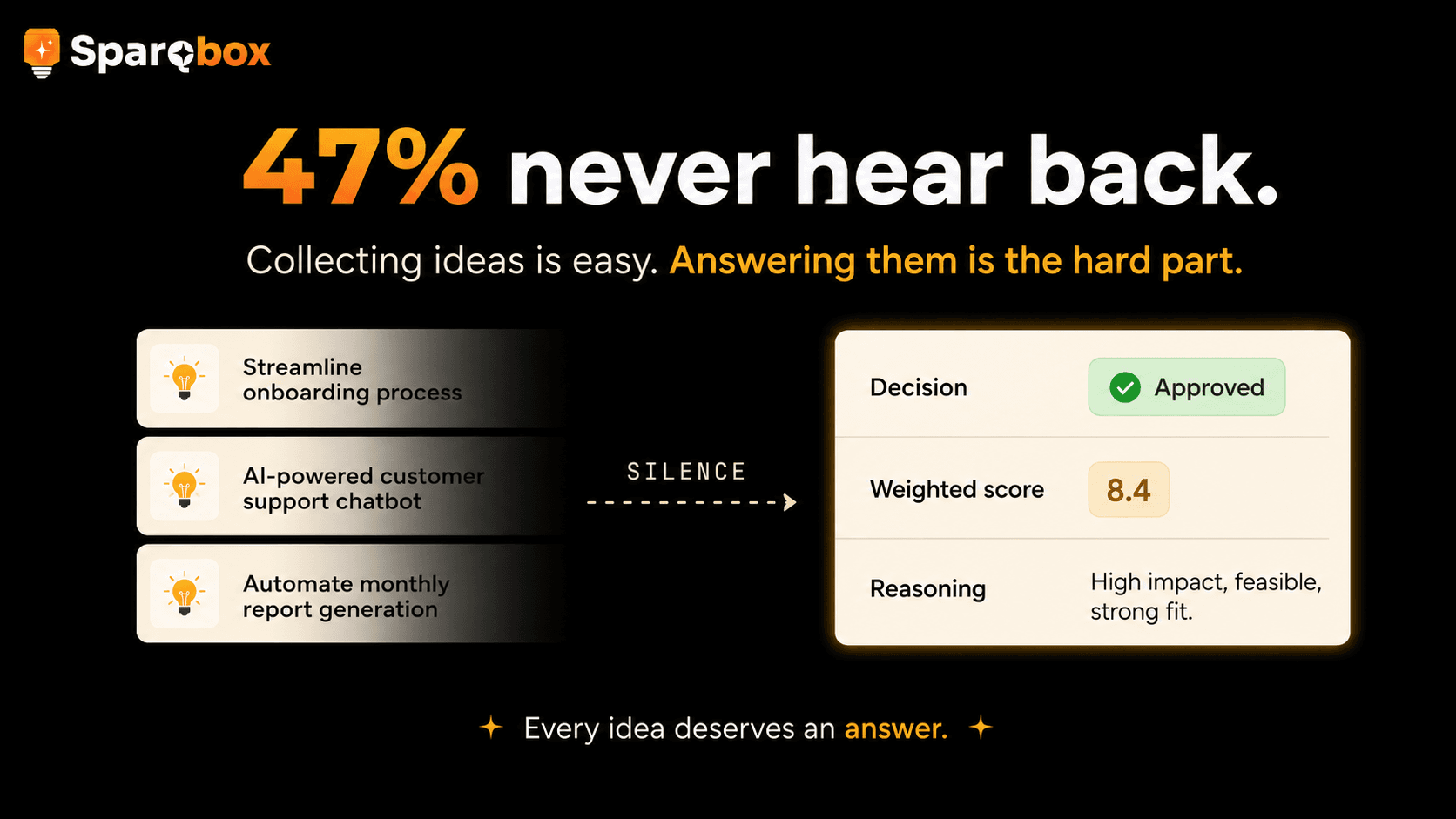
The first time an employee submits an idea inside a typical company, three things happen. They write it up, which takes effort. They send it somewhere, which involves figuring out who the right recipient is. And then they wait. If they get a clear answer, the submission feels productive, regardless of whether the answer was yes or no. If they get no answer, they learn that submitting is work that disappears.
Most companies do not realize how thoroughly that single experience generalizes. An employee who submits one idea and hears nothing back does not just decide not to submit that idea again. They decide, often without thinking about it consciously, that submitting ideas to this company is not how they will spend their attention. Then they tell their team. By the time leadership notices the box is empty, the team has been operating on this conclusion for months.
This is the structural starting point for any honest attempt to fix the problem. The empty box is not a sign of an idea drought. It is a sign that the people who used to submit have made an updated decision. Anything that does not address that decision will not change the outcome.
Reason 1: They did not get an answer last time
The single strongest predictor of whether employees keep submitting is whether previous submissions got a clear answer. Not the right answer. Any answer. Approval, rejection, hold for later with a date, ask for more information, route to another team. Anything that closes the loop counts.
The TU Eindhoven research that Sparqbox is built on identified mandatory feedback as the most predictive variable for whether an idea program survives past its first year. The same finding holds today. In dozens of programs Dennis has observed, the difference between an active pipeline and an empty box has almost always come down to whether the company answered last year's submissions, even when the answers were unfavorable.
The trap most companies fall into is the assumption that rejecting an idea will hurt morale more than ignoring it. The opposite is true. A rejected idea with a one-line reason is closure. The submitter knows the idea was considered, knows it did not move forward, and can submit something different next time with no loss of trust. An ignored idea is the worst of both worlds: the submitter does not know if the idea was considered, does not know if they should follow up, and does not know if a different idea would do any better.
Closing the loop on existing open submissions is the single highest-impact action available to any company with an empty box. It is also the first thing most companies skip when they try to "relaunch" an innovation program.
Reason 2: The submission process takes too much effort
The second reason employees stop is the friction at the moment of capture. Long forms with required fields for business case, expected ROI, implementation plan, and dependencies. Templates that require a polished presentation of an idea that is, by definition, still half-formed. Multi-step submission flows that demand a level of preparation most submitters do not have at the moment the idea occurs to them.
This is a design problem disguised as a quality problem. Companies justify the friction by saying they want "serious" ideas, not "casual" ones. The result is that the only ideas that get submitted are the ones from people overconfident enough to invest the effort. Most of the best early-stage ideas come from people who are tentative, who suspect the idea might be naive, and who would not write a business case for an idea they are not yet sure of. Those people walk away from the submission form.
The fix is to make the submission cheap. A title, a description, a category. Everything else is optional or asked later in the process. The submitter does not need to defend the idea before the company has decided it cares.
Reason 3: Submitting feels political
The third reason is social cost. If submitting an idea routes it to your manager's manager, makes it visible to the whole company, or marks you as "the person who keeps suggesting things," the submission carries political weight. The weight is asymmetric: the downside of submitting a flawed idea in a visible forum is larger than the upside of submitting a successful one, especially in cultures where being seen as a critic of the status quo is risky.
This is not a hypothetical. Dennis has interviewed employees in dozens of companies who said, in the same phrasing each time, that they had stopped submitting because they did not want to be "that person." The companies in question often had visible innovation programs, prizes for the best ideas, and explicit calls for participation. They also had unstated norms about what kinds of ideas were welcome and from whom. Employees read those norms accurately and acted on them.
The structural fixes are real and not complicated. Anonymous submission as an option, not a default. Private submission with controlled visibility. Routing rules that do not force every idea past three layers of management before evaluation. A submitter's identity should be a setting they control, not something the system imposes.
Reason 4: Past submitters were never visibly rewarded
The fourth reason is the absence of visible upside. If the last employee whose idea got implemented received no credit, no mention, no acknowledgment, future submitters learn that the upside of submitting is invisible. Even when the rational case for submission is strong, the visible evidence says otherwise.
This is not an argument for prizes. Prizes tend to backfire, for reasons covered in the next section. It is an argument for institutional visibility: when an idea moves through the pipeline and gets implemented, the submitter's name should be attached to it publicly, the outcome should be reported back to the company, and the path from idea to implementation should be observable. Without this, the company is asking employees to submit ideas into a black box and trust that something good happens at the other end. Most employees, having seen no evidence to support that trust, do not extend it.
Why incentives don't fix it
The standard fix for an empty suggestion box is to add an incentive. A prize for the best idea each month. A percentage of cost savings for implementation ideas. A wall of fame. These work briefly, then stop working, then make the underlying problem worse. There are three reasons.
Prizes shift the bar. An idea no longer just has to be useful. It has to be "good enough to win." Employees self-filter out anything they do not think will compete, which means most of the early-stage ideas (which are the most valuable, because they have not yet been thought of by anyone with more authority) never get submitted.
Prizes attract submission volume from people optimizing for prizes, not from people with good ideas. The submission queue fills with optimized proposals from a small group of repeat submitters, and the broader employee base concludes that the program is not for them.
Prizes do not address trust. The variable that determines whether employees submit is whether they trust the process to give them an answer. A prize-driven program with no feedback loop is still a program with no feedback loop. The prize does not fix the silence.
The general pattern: incentives without process create more friction, not less. The order matters. Get the process right first. Decide later whether the program needs incentives at all. Most do not.
What actually changes the pattern
Three things move the needle. They are not glamorous. They have to be done in order.
First, close the loop on every existing open submission. Go back through the email inbox, the spreadsheet, the suggestion box, the Teams channel, whatever the current submission graveyard is. Every idea that has not received a response gets one now: approved with next steps, declined with a reason, held with a date for revisit. Some of those submitters left the company, and the response will not reach them. That is fine. The point is to establish, internally, that ideas no longer disappear here.
Second, drop the friction of submission. Title and description only as required fields. Categories optional, attached after submission. Submission UX that takes thirty seconds, not thirty minutes. The goal is to make the cost of submitting an idea lower than the cost of mentioning it in a meeting, because mentioning is currently winning.
Third, make the process and the outcomes visible. Every employee should be able to see, in a single place, what happened to last quarter's submissions. Which were approved. Which were rejected. Which were implemented. Who submitted them. What the implementation outcomes were. This visibility is the institutional evidence that submission is not a black box. Without it, the trust does not rebuild.
These three steps are the SMB-sized version of the architecture the TU Eindhoven research identified. Single point of capture. Mandatory feedback loop. Transparent pipeline. They work without software, but the discipline is hard to sustain by hand. The reason Sparqbox exists is to make the discipline structural, not personal. Read more about how the underlying evaluation process works, or how the five moments where ideas die connect to the empty-box pattern at the front end.
Common questions
Why doesn't a suggestion box work in most companies?
Because a suggestion box collects ideas but does not evaluate, route, decide on, or respond to them. The collection step is the cheapest part of the problem. The structural failures happen after the idea is submitted, and a suggestion box does nothing to address them. Employees who submit and get no response learn not to submit again, and the box goes quiet.
Is an empty suggestion box a sign of bad culture?
No. It is a sign of accurate learning. Employees stop submitting when previous submissions produced no answer, not when they have stopped caring. The diagnosis matters because the wrong diagnosis (culture) leads to the wrong interventions (engagement campaigns) that do not address the actual cause (no feedback loop).
Do prizes for the best idea increase submission rates?
Briefly, and then they stop. Prize-driven programs raise the bar for what counts as a "good enough" idea to submit, which filters out the early-stage ideas that have the most value. They also attract a small group of repeat submitters optimizing for prizes, which crowds out broader participation. The deeper problem (trust in the process) is unchanged by a prize.
How long does it take to fix an empty suggestion box?
The first signal usually shows within four to six weeks of closing the loop on existing open submissions, dropping the friction of new submissions, and making the pipeline visible. Submission volume increases first. The quality of submissions increases more slowly, over three to six months, as employees re-learn what kinds of ideas the company actually engages with.
Should anonymous submissions be allowed?
As an option, yes. As a default, no. Anonymous submission removes the political cost for employees in higher-risk positions, which surfaces ideas that would otherwise stay private. But making anonymity the default removes the institutional visibility that submitters need to see their contributions acknowledged. Per-submission opt-in is the right design.
The takeaway
An empty suggestion box is information. It tells you that the previous people who submitted did not get what they needed, and that the people who are left have updated their behavior accordingly. Reading the information correctly is half the work. The other half is the three actions: close the loop on what is already in the queue, drop the friction of new submissions, and make the process visible.
None of the three requires prizes. None requires a culture campaign. All three require discipline. Sparqbox is the structural enforcement of the discipline at a scale where doing it by hand stops being practical. The architecture follows from the diagnosis.