Employees distrust AI reading their ideas. Here is where the line sits
Engagement research keeps finding the same risk: trust drops when employees learn AI reads their input. The line that protects trust is simple. AI scores first. People decide.
By Dennis Jacobs
The fear is not that AI judges your idea. It is that nobody human ever will.
That sentence captures what most engagement research misses when it reports that employees distrust AI. The discomfort is rarely about the model itself. It is about the suspicion that once a machine reads your input, no person ever reads it again. The submission goes into a system, a score comes out, and a human stamp on the decision starts to feel like a formality. That is the moment trust leaves the room. So the real design question is not whether to use AI when employees share ideas. It is where the line sits between what AI does and what a person owns. Sparqbox draws that line in one fixed place, and the line never moves.
Why this matters
The 2026 employee engagement research is consistent on one point. The single biggest risk to engagement, when a company introduces AI into people-facing processes, is the perception that decisions about humans are now made by software. Employees can accept that a tool helps. They struggle to accept that a tool decides. The contactmonkey research on AI and engagement lands on the same finding from a different angle: AI raises productivity, and it raises anxiety, in the same motion. The variable that decides which one wins is trust.
Idea programs are unusually exposed to this. An idea is not a help-desk ticket. It is a piece of someone's thinking, often something they have sat on for months before submitting. When an employee finally writes it down and hits submit, the worst possible outcome is silence dressed up as process. They suspect the AI filed it, scored it low, and routed it to a folder no manager will open. Whether or not that is true, the suspicion alone is enough to stop the next submission. And the cost of that is concrete. A program that loses submitter trust does not produce fewer good ideas. It produces a slow drain of the ones most worth having, because the people with the sharpest ideas are the first to notice when the loop is hollow.
There is a second cost that is easy to miss. When employees believe AI made the call, they stop arguing with the decision, and that silence looks like acceptance. It is not. A reviewer who disagrees with a human decision will say so, and that friction is healthy, because it surfaces the context the system did not have. A reviewer who assumes the machine decided says nothing, shrugs, and disengages. The program loses not just the submitter but the internal challenge that keeps scoring honest. You end up with a process that looks calm on the surface and is quietly rotting underneath.
So the stakes are not abstract. Get the AI boundary wrong and the program dies quietly, not from a bad decision but from a credibility gap. Get it right and AI does real work without ever touching the part employees actually care about: whether a person looked.
How Sparqbox handles it
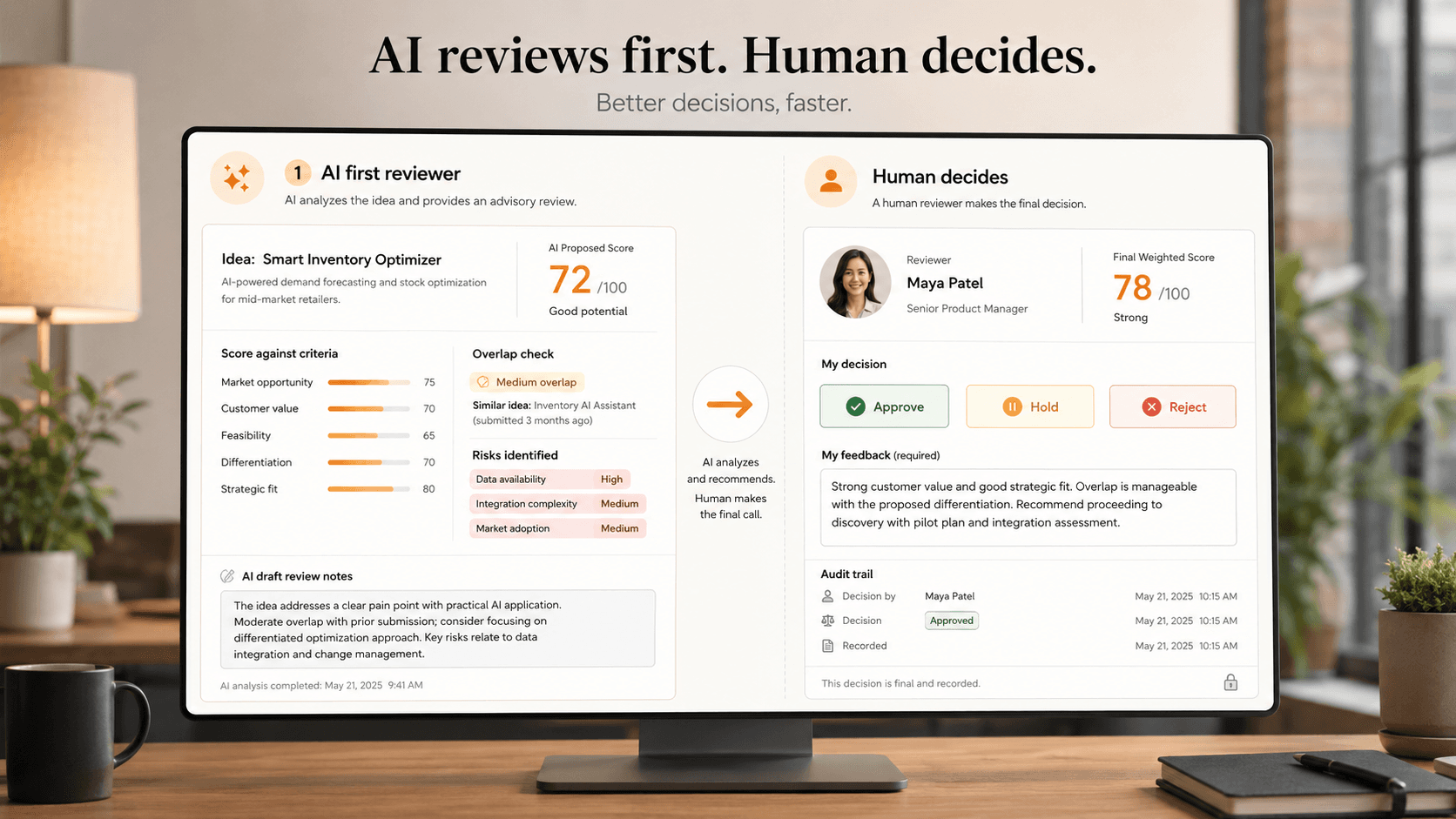
The boundary in Sparqbox is one sentence. AI scores first. People decide. Everything in the product is built to keep those two halves separate and visible.
Here is the sequence. An employee submits an idea through a guided form into a strategic bucket, for example Process Improvement or Cost Reduction. Each bucket has its own set of criteria, and each criterion carries a weight that an admin configured. Customer Needs might carry a weight of 0.200, Feasibility 0.150, and so on, summing to one. The AI first reviewer, running on the Claude API, reads the idea and scores it against exactly those criteria. Not against a vague sense of quality. Against the same configured criteria a human reviewer will use. The output is a weighted score, which is the sum of each criterion score multiplied by its weight. Deterministic math, not opinion.
That is where the AI stops. It does not decide. It does not route the idea to approval or rejection. It produces a first pass and hands it on.
Human reviewers then score the same idea independently against the same criteria. They do not see a recommendation labelled approve or reject. They see the idea, the criteria, and their own scoring task. Their weighted score is calculated the same way. Then the automatic decision fires, based on per-category thresholds: a weighted total at or above 3.5 approves, at or below 2.0 rejects, and the band in between is needs discussion. The threshold is the rule. The AI score is an input to that rule, sitting beside the human scores, never above them.
Two things follow from this design, and they are the things that protect trust.
First, the AI never overrides a human. There is no path in the product where an AI score reverses or vetoes a reviewer. The reverse path exists instead: an admin can override a decided status, and that override requires a written justification that lands in the record. Authority runs from people downward, not from the model.
Second, every score is auditable. A reviewer can see what the AI first reviewer scored on each criterion and disagree with it openly, criterion by criterion. Disagreement is not a system error. It is the point. When a reviewer scores Feasibility two points below the AI, that gap is visible, recorded, and part of the decision. The human judgement is not laundered through the machine. It sits next to it.
There is a practical reason the AI runs first rather than last. A first pass gives every idea a consistent, fast read against the criteria, which is exactly the work humans do worst at scale. Reviewers get tired, they anchor on the last idea they saw, and they apply the rubric loosely on a Friday afternoon. The AI does not. It scores the fortieth idea the same way it scored the first, against the same criteria, in the same two minutes. That consistency is real value, and it is value that does not require the model to decide anything. It just has to be steady. The human reviewers then bring what the model cannot: the licensing detail, the political history of a department, the knowledge that a similar idea failed two years ago for reasons that never made it into writing.
One thing Sparqbox does not claim today: it does not detect bias in scoring. Automated bias detection is on the roadmap, not in the product. Saying otherwise would be the exact kind of overreach this whole boundary exists to prevent. What Sparqbox offers now is transparency, not a bias guarantee: you can see every score and who produced it, which is the precondition for catching bias, but it is not the same as the software doing it for you. If a reviewer consistently scores ideas from one team lower, the record makes that pattern visible to an admin who goes looking. The software does not raise the flag on its own yet. Honesty about that gap is part of the point.
A real example
Take a real shape of idea. An employee in operations submits "Move the Friday production handover from email to a shared board, so the weekend shift stops losing context." It goes into the Process Improvement bucket. That bucket scores against four criteria: Impact on Operations, weight 0.300; Feasibility, weight 0.250; Cost to Implement, weight 0.250; Customer Needs, weight 0.200.
The AI first reviewer scores it within two minutes. It reads the idea as cheap and feasible, and it scores Impact on Operations at 4 out of 5, Feasibility at 5, Cost to Implement at 5, Customer Needs at 2, because the idea does not obviously touch a customer. Weighted, that is roughly 4.0. A clear approve on the AI pass alone.
Then two human reviewers score independently. One of them runs the weekend shift. She scores Impact on Operations at 5, not 4, because she has watched context get lost every Monday for a year. But she scores Feasibility at 3, not 5, because she knows the shared board the AI assumed is available has not been licensed for the shop floor. The AI did not know that. It could not. That is context, and context is precisely what the human reviewer holds and the model does not. Her weighted score comes in lower than the AI's, around 3.6, still above the approve threshold but for different reasons and with a real caveat attached.
The automatic decision fires: approved, with the licensing caveat now visible in the record. The submitter gets a reference number, the decision, and the actual reasoning, including the feasibility flag the human added. What she hears back is not "the AI liked your idea." It is a decision with a human fingerprint on it, traceable to a person who knew something the model did not.
Founder lens
I built the boundary this way because of what I studied, not in spite of it. My Master's thesis at TU Eindhoven was on idea selection, and the uncomfortable finding underneath it is that selection methods fail less often on the math and more often on legitimacy. People stop trusting a process the moment they sense their judgement has been removed from it. AI makes that failure mode cheaper and faster to fall into, because it is genuinely good at the consistent, repetitive scoring work, and that competence is seductive. It is tempting to let it decide.
I will not let it. Not because the model is weak, but because the legitimacy of the whole program depends on a person owning the decision and being seen to own it. Sparqbox uses AI for what it is good at, which is a fast, consistent first pass against configured criteria. It keeps people where they belong, which is the deciding. I would rather be honest that bias detection is a roadmap item than ship a claim I cannot stand behind. The line holds because it is the product, not a setting.
Takeaway
If you are putting AI anywhere near employee ideas, hold a few things fixed.
- Decide where the line sits before you turn anything on, and make it one sentence your employees can repeat back to you.
- Let AI score first against the same criteria a human will use, so the AI pass and the human pass are comparable, not separate worlds.
- Never let an AI score override a reviewer. Authority runs from people down.
- Make every score auditable, criterion by criterion, so disagreement is visible rather than buried.
- Claim only what is shipped. If bias detection is on your roadmap, say roadmap, not feature.
AI can read every idea. It just does not get to be the one who answers.