Why 47 percent of companies never close the feedback loop
Nearly half of companies collect employee ideas but only sometimes say what happened to them. The fix is not another suggestion box. It is a mandatory feedback loop where every idea gets a real answer.
By Dennis Jacobs
Why 47 percent of companies never close the feedback loop
Most companies are good at collecting ideas and quietly terrible at answering them.
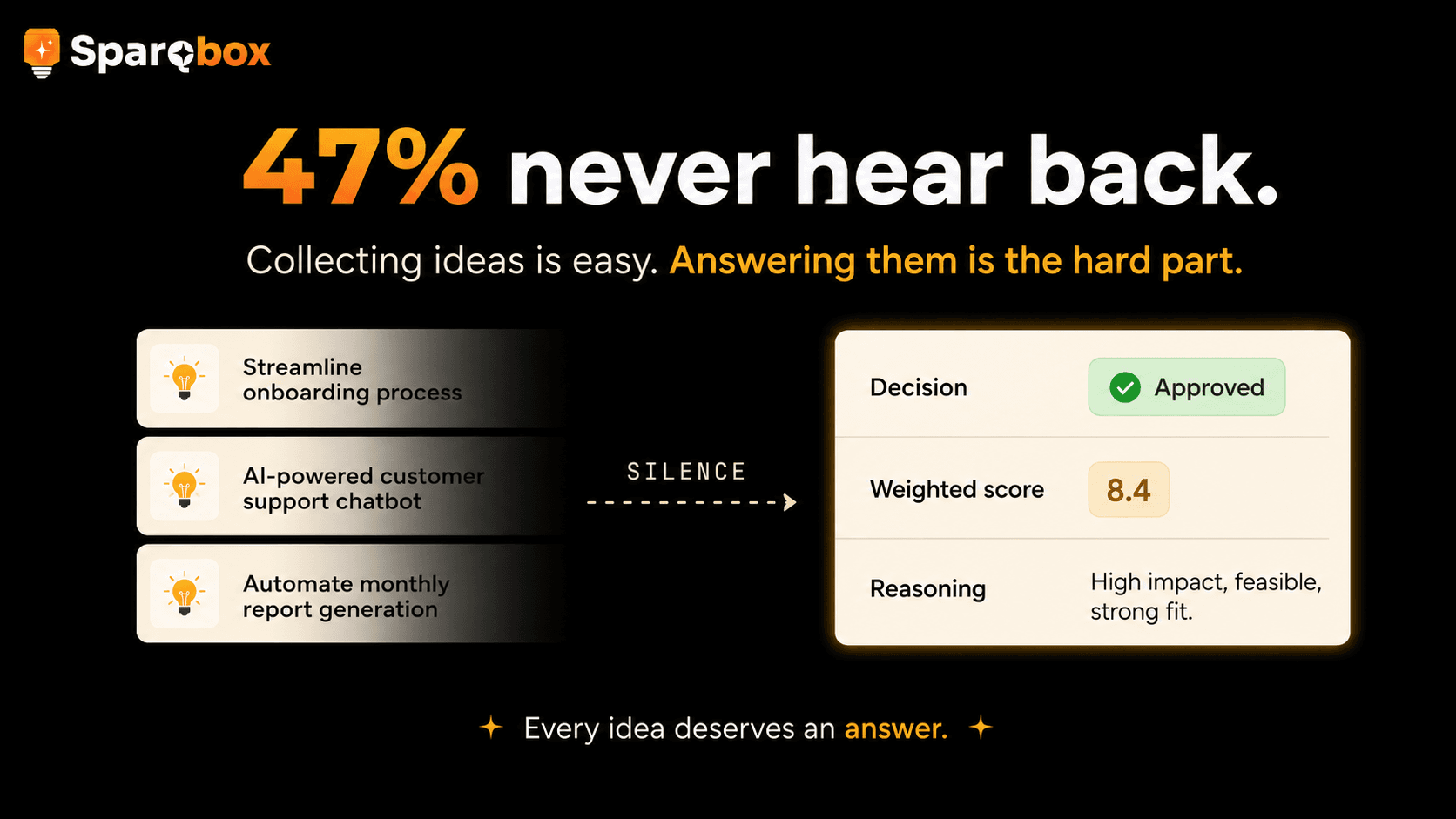
A 2026 study of employee feedback programmes found that 47 percent of organisations only sometimes tell people what action came from their input. Not never. Sometimes. That one word is where idea programmes go to die. Collecting ideas is the easy half. Put up a form, run a workshop, open a channel, and submissions arrive. The hard half is the reply. Every idea that comes in creates a small debt: someone now expects to hear what happened to it. When that debt goes unpaid often enough, people stop submitting, and the programme that was meant to surface good thinking slowly teaches the whole company that ideas do not matter here. Closing the loop is not a nicety bolted onto an idea programme. It is the programme.
What silence actually costs
Idea programmes rarely fail loudly. They fail through attrition, one unanswered submission at a time.
Picture a logistics company with 200 employees. A warehouse supervisor submits a suggestion about a recurring bottleneck in the Friday handover. It is a good idea, grounded in something she sees every week. Weeks pass. Nothing comes back, not even an acknowledgement that the idea was read. The next time she notices a problem worth fixing, she thinks twice about writing it up. The time after that, she keeps it to herself and works around the issue privately. No one decided to silence her. The silence did it on its own.
Now multiply that supervisor across the building. The cost is not one lost idea. It is a slow drift toward a culture where the people closest to the work have learned that speaking up leads nowhere. That is far more expensive than any single suggestion, because the ideas you never hear about are the ones you cannot evaluate, fund, or fix.
The usual culprit is not laziness. It is a missing process. Ideas land in a manager's inbox, a shared spreadsheet, or a suggestion box, and there is no agreed step that says someone must respond, by when, and with what. So the default takes over, and the default is "interesting, I will come back to that." Most of the time, no one ever does. A polite silence and a vague "we will consider it" feel kinder than a flat no. They are not. They leave the submitter guessing, and guessing eventually turns into giving up.
There is a second cost hiding behind the first: the manager bottleneck. In most companies the only person who can answer an idea is the same person already running the team, sitting in the meetings, and clearing their own inbox. Triage falls to the bottom of the list because nothing forces it to the top. Ideas pile up not because someone judged them and said no, but because no one had a spare hour to judge them at all. The submitter cannot tell the difference between "we looked and declined" and "no one ever looked," so both read as the same silence. Every ignored cycle makes the next round of submissions a little smaller, until the programme is quietly running on the few people stubborn enough to keep trying. That is what "sometimes" looks like from the inside: not a policy, just a queue that never clears.
How Sparqbox closes the loop
Sparqbox treats the answer as a required step, not a hopeful one. The loop is built into the path every idea takes, so closing it does not depend on a busy manager remembering to.
It starts with structured submission. An employee submits through a guided form tied to a category, what Sparqbox calls a strategic bucket, such as Process Improvement or Cost Reduction. Each category carries its own set of criteria, and each criterion has a weight that reflects how much it matters for that kind of idea. Customer Needs might carry a weight of 0.200, implementation effort another. The weights are set once, per category, and then they apply to every idea in that bucket.
The AI first reviewer scores the idea first. It reads the submission and scores it against the configured criteria before any human spends time on it. This is not the AI deciding anything. It is the AI doing the consistent, tireless first pass: applying the same criteria the same way to every idea, so nothing sits unread for a week waiting for a free moment.
Then human reviewers score independently on the same criteria. They do not see the AI score as a verdict to rubber-stamp. They score, and Sparqbox calculates the weighted score as the sum of each criterion score multiplied by its weight. The result is a number that comes from the math, not from whoever happened to be in the room or in the best mood that afternoon.
That weighted score drives an automatic decision against thresholds set per category. A common configuration approves an idea at or above 3.5, rejects at or below 2.0, and routes anything in between to a needs discussion state for a human conversation. Because the thresholds are defined in advance, the decision is predictable and explainable. An admin can override a decided status, but the override requires a written justification, so even the exceptions leave a trail.
The needs discussion state is the part teams underestimate. A binary approve or reject forces a verdict on ideas that genuinely sit on the line, and forcing it too early is how good ideas get killed and weak ones get waved through. Routing the middle band to a human conversation keeps the decision honest without leaving the idea in limbo, because needs discussion is still a status the submitter can see, not a synonym for forgotten. And because every score, weight, and threshold is recorded against the reference number, anyone can later ask why an idea landed where it did and get a real answer. A reviewer who disagrees with the AI first reviewer can say so on the record, and the disagreement becomes part of the idea's history rather than an argument lost in a hallway.
The part that matters most for the feedback loop comes last and is not optional. Every submitter receives feedback. Every idea carries a reference number, something like IDEA-2026-0001, and the submitter gets back the decision, the score behind it, and the reasoning. Approve, reject, or needs discussion, the answer goes out. There is no path through the system that ends in silence, because silence is the failure mode the whole design exists to remove.
One idea, start to answer
Take a concrete case. A maintenance technician submits an idea: replace the paper Friday handover sheet with a shared digital checklist that the next shift can see before they arrive. He files it under Process Improvement and gives it a reference number on submission, IDEA-2026-0214.
The AI first reviewer scores it against the category criteria. It rates the idea well on clarity and on fit with an existing problem, but flags it low on one criterion, estimated implementation effort, because the submission mentions integrating with two systems that usually take real work to connect. The early score lands around 2.9.
Two human reviewers then score independently. One of them runs the shop floor and knows something the model could not: the two systems already share a connector that another team built last quarter, so the integration effort is much smaller than it looks on paper. She scores the effort criterion far higher than the AI did. With the human input, the weighted score moves to 3.6, just over the approval threshold for that category.
The automatic decision fires: approved. The technician does not hear nothing, and he does not hear a vague maybe. He receives the decision, the weighted score, the criterion-by-criterion breakdown, and a short note that the effort concern was checked and resolved. He also sees that another colleague had submitted a similar idea and was recorded as a supporter. The whole exchange, from submission to a reasoned answer, is a closed loop, and he has every reason to submit the next idea too.
Why I made the answer mandatory
When I researched idea selection across companies for my thesis at TU Eindhoven, the pattern that stayed with me was not that companies lacked ideas. They had plenty. They lacked a way to answer them. Good ideas died not because they were bad but because no one ever closed the loop, and the people who raised them quietly stopped raising more.
So when I built Sparqbox, I made the answer the one step you cannot skip. We argued about a lot of defaults, but never about that one. You can configure your categories, your criteria, your weights, and your thresholds however you like. What you cannot do is let an idea fall into silence, because that single failure is what kills programmes, and I have watched it happen too many times to leave it to good intentions.
What to do on Monday
You do not need software to start fixing this. You need to treat the reply as part of the job.
- Pick the one place ideas already arrive in your company, and count how many got a real answer last quarter. The number is usually lower than people expect.
- Write down the decision rule before the next idea lands: who responds, within how many days, and what a real answer includes. Vagueness is what lets silence win.
- Give every idea a reference and a status the submitter can see, so "I never heard back" stops being possible.
- When the answer is no, say no, and say why. A reasoned rejection keeps people submitting. A polite silence does not.
The companies that win the trust of their own people are not the ones with the fullest suggestion box. They are the ones that answer. Every idea deserves an answer, and acting like it is the cheapest culture upgrade you will ever make.