The five moments where ideas die in your company
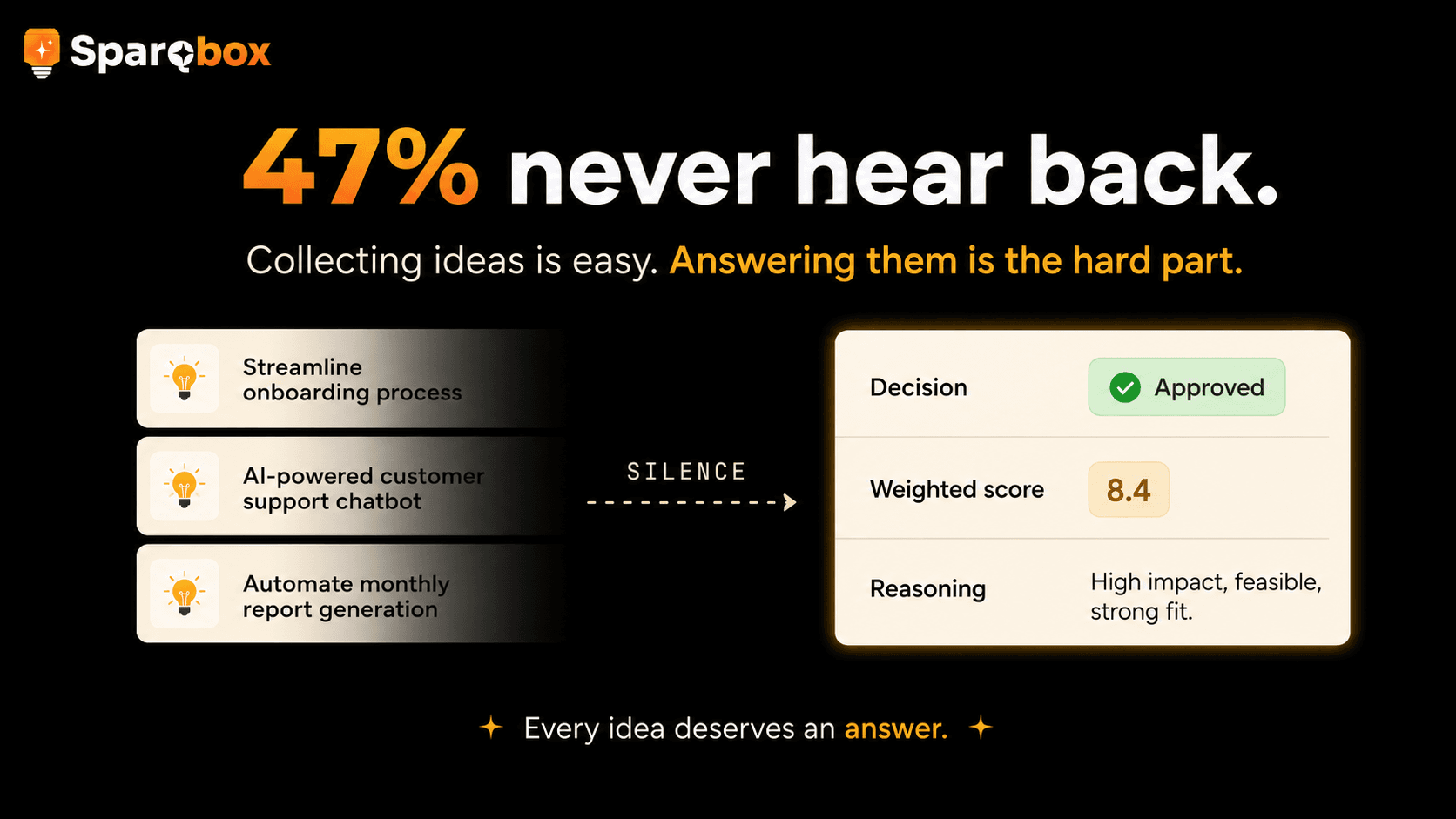
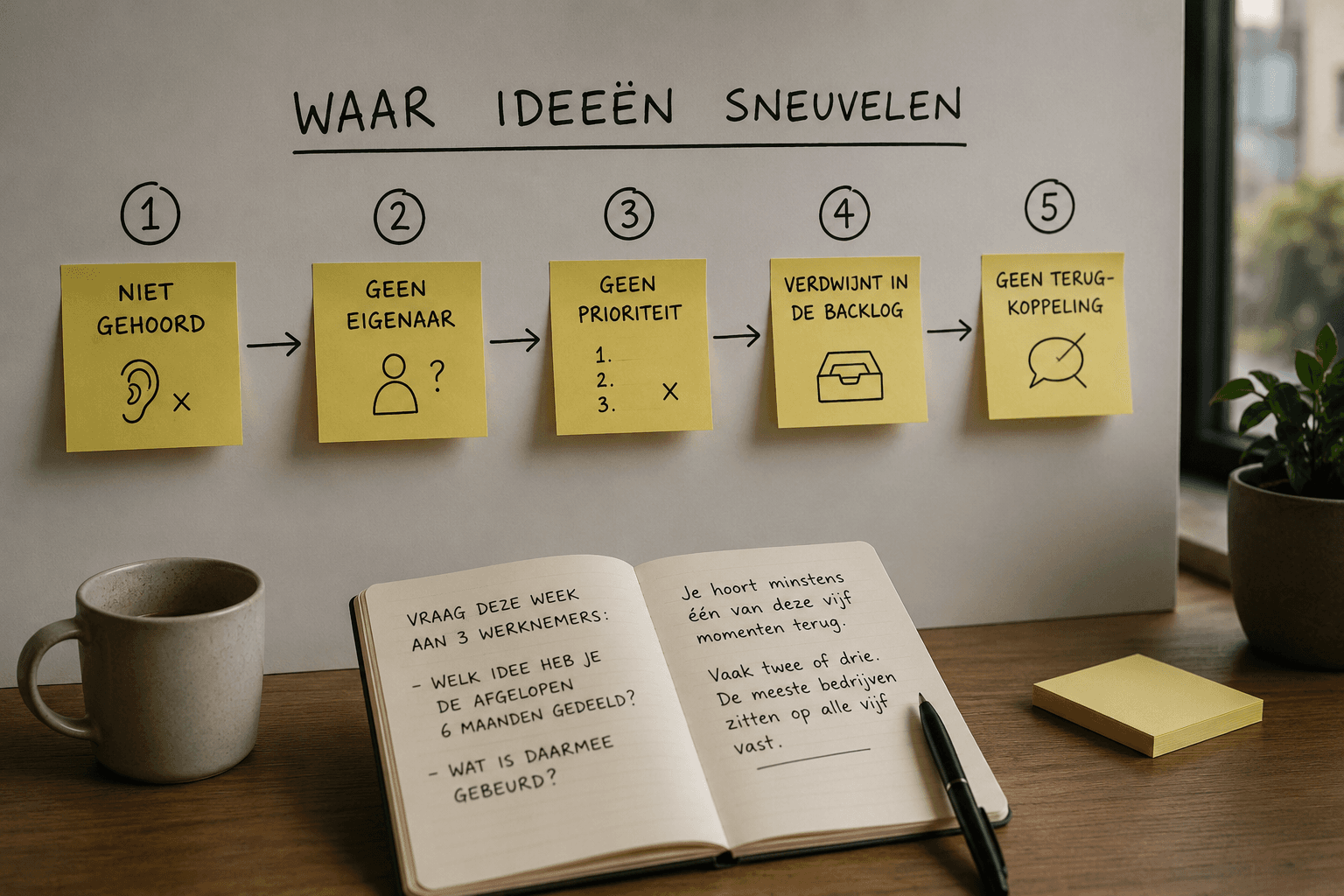
Employee ideas don't die because people stop having them. They die at five specific moments inside the company (never being written down, landing in the wrong inbox, the 'interesting, I'll come back to that,' missing the leadership agenda, and being approved with no owner), and most companies have no process for any of them.
By Dennis Jacobs
The five moments where ideas die in your company
Employee ideas don't die because people stop having them. They die at five specific moments inside the company: never being written down, landing in the wrong inbox, getting an "interesting, I'll come back to that," missing the leadership agenda, and being approved with no owner. Sparqbox's founder, Dennis Jacobs, has watched all five happen in companies that thought they had an idea problem. They had a process problem.
Companies in the 50 to 500 employee range typically run idea programs the same way. A suggestion box. A generic email address. A monthly innovation meeting. Maybe a poster on the wall asking for "your great ideas." When the box stays empty or the email goes unread, leaders blame culture. The truth, in nearly every case Dennis observed during his ten-plus years working with innovation programs, is structural. Ideas don't survive the building. There is no single point of failure. There are five. Each one is fixable, but only if you know it exists.
Moment 1: It never gets written down
Someone mentions it at a team lunch. They raise it in a one-on-one. They float it in the hallway after a meeting. The manager says "good thinking, we should do something with that." There is no place for the idea to go next. No form to submit. No inbox to forward it to. No log it lands in. The idea exists for thirty seconds in conversation, then it evaporates.
This is the most common moment, and it is structural, not personal. Employees are not lazy or unmotivated. They have observed, correctly, that submitting an idea takes effort and produces nothing. So they default to mentioning, not submitting. Mentioning is free. Submitting feels like work that disappears.
The fix is to make submission the cheapest possible action. One short form. One click. A confirmation that the idea is somewhere, anywhere, that someone owns. The submitter does not need a status update in five minutes. They need to know the idea has not vanished. Dennis benchmarked 50 companies for his TU Eindhoven master's thesis on idea selection, and the pattern was the same in every poorly-performing program: friction at the moment of capture killed the pipeline before evaluation ever started.
Moment 2: It lands in the wrong inbox
The idea was written down. The employee did send it. The trouble is they sent it to whichever manager happened to be in front of them at that moment. The manager who heard it cannot decide on it. So the idea has to be forwarded.
Forwarding takes momentum. Each handoff in an idea's life is a place where it slows down, and slowing down means dying. Manager A forwards to manager B with a short note. Manager B reads the note, not the idea, and forwards to manager C with even less context. By the time the idea reaches someone who could actually act on it, two things have happened. The originating employee has stopped expecting an answer. And the idea has become a third-hand summary that nobody owns.
In the 50-company benchmark, the best-performing programs all had a single, named owner of incoming ideas. The role goes by different titles. Innovation manager. Idea coordinator. Process lead. The function is the same: the idea always lands in one place. Routing happens after that, against rules everyone understands, but the entry point is fixed.
When the entry point is fixed, two structural problems disappear. Employees stop guessing where to send things. And ideas stop dying in transit between inboxes that were never meant to evaluate them.
Moment 3: It gets the "interesting, I'll come back to that"
This is the moment that kills the most viable ideas, and the one almost nobody talks about.
The idea has been written down. It has reached someone with authority over the area it touches. That person reads it. They reply: "Interesting, let me come back to this." Not no. Not yes. Not next steps. Just a pause that the submitter has to assume will resolve itself.
It rarely does. Two weeks later the submitter checks in, gently, and gets a "I haven't gotten to it yet, I'll let you know." Two weeks after that there is no third check-in, because checking in feels like nagging. The idea now lives in the inbox of a person who has stopped intending to look at it. And the submitter has learned that submitting ideas to this manager is not productive use of energy.
In Dennis's TU Eindhoven research, this was the silent killer. Companies that scored worst on the success factors of their idea selection programs were not the ones that rejected ideas openly. They were the ones that never gave a clear answer in either direction. Rejection at least closes the loop. The "interesting, I'll come back to that" leaves it open forever, which is functionally worse than rejection because it accumulates. Across 50 ideas over a year, a manager who replies this way to even a quarter of them has created a pipeline of un-decided work that nobody can act on.
The fix is not faster decisions. The fix is decisions, full stop. An idea that gets a documented no with a one-line reason is healthier than an idea that gets "interesting" and a silence.
Moment 4: It doesn't make the leadership team agenda
The idea has made it past the silent killer. Someone has decided it deserves a real review. It is now on a list of things to be discussed at the next leadership team meeting, or innovation board, or steering committee.
Then it gets pushed back. Something more urgent comes up. The agenda is full. The committee meets every two weeks, and the idea is item number nine, and they only got to item six. Two weeks later the idea is item number twelve and they only get to seven. Eight weeks later, the originating employee has either left the company, lost interest, or both, and the idea is quietly removed from the list.
This is a scheduling problem disguised as a prioritization problem. Leadership teams are not malicious. They are overloaded, and they tend to use meeting time on the loudest immediate problems instead of the slowly compounding ones. Idea review is almost never the loudest problem in the room, which means it is almost always the one that gets cut.
The structural answer is not "make innovation a higher priority." It is to take idea evaluation off the leadership team's plate for everything except the few decisions that genuinely require their input. Dennis's thesis benchmarking found that high-performing programs delegated routine scoring to a cross-functional Innovation Committee with the authority to act, escalating only the small percentage of ideas that required real capital allocation. Everything else got decided at the committee level, on a fixed cadence, with no agenda pressure from unrelated topics.
When idea evaluation has its own time and its own owners, it stops competing with quarterly results for attention. And it actually finishes.
Moment 5: It's approved, then nothing happens
This is the heaviest moment, because the submitter saw a green light and built expectation around it.
The idea got reviewed. The committee said yes. Everyone in the room nodded. Someone wrote "approved" next to it in the meeting notes. And then, six months later, when the original submitter asks what happened with their idea, the answer is some variation of: "Oh yes, we said we would do that. We should have."
There was no named owner. No budget. No date. No follow-up cadence. The approval was a moment in time, and the moment passed.
This is the most damaging of the five because it teaches the entire company a harder lesson than rejection does. Rejection teaches employees that their idea was not the right one. An unfulfilled approval teaches them that even the right ideas do not survive the company. That second lesson is contagious. Once a few of them accumulate, the next submitter shrugs and decides not to bother, regardless of how strong their idea is.
Approving an idea is not a decision. It is the start of a decision. The real decision is who owns the next step, what the budget is, and when it will be reviewed. If those three things are not written down on the same day as the approval, the approval did not happen. Sparqbox enforces this in software, but it does not need software to be true. Any organization that wants idea approvals to actually mean something has to treat the approval as an event that triggers ownership, not as the end of the conversation.
Where the five moments come from
If you read those five moments looking for a common thread, you find one. Each is a place where the idea changes hands. From the employee's head to a written submission. From the wrong inbox to the right one. From "I'll look at it" to a decision. From a decision to a meeting agenda. From an agenda to an owner. Five moments, five handoffs, five places where momentum can be lost.
Most companies invest in the wrong thing when they try to fix this. They invest in generating more ideas. Innovation days. Hackathons. Suggestion boxes with prizes. The pipeline already has enough ideas. The pipeline has handoff failures.
The five-moment pattern is what Sparqbox's founder spent his TU Eindhoven thesis researching, and it is the architecture the product is built to enforce. Every idea has a single point of entry. Every idea has a named owner from the first hour. Every idea gets a decision, recorded in an append-only log so that the silent killer cannot operate. Every approval is structurally incomplete until ownership and a next-review date are attached. And the work of evaluating ideas happens on a cadence that is its own, not a leftover slot on a leadership team's agenda.
The five moments are not a Sparqbox claim. They are observable in any company over the course of an afternoon. What software does is close them.
What to do this week
If you want to test how badly your company is hit by the five moments, ask three of your employees a single question: "What is the most interesting idea you've mentioned to a manager in the last six months?" Then ask, "What happened to it?"
You will hear at least one of the five moments in the answer. Often you will hear two or three. The point of the exercise is not to assign blame. It is to make the moments visible to the people who can fix them.
Once the moments are visible, the fix sequence is consistent across the dozens of organizations Dennis has observed:
- Build a single point of capture.
- Name a single owner of incoming ideas.
- Replace "interesting, I'll come back" with a one-line decision, every time.
- Take routine idea evaluation off the leadership team's agenda and give it its own cadence.
- Treat approvals as incomplete until ownership and a review date are written down.
If you do those five things consistently, you do not need software. Sparqbox just makes them harder to skip. If you want to see what enforcement actually looks like, read about how the evaluation process works, or how Sparqbox compares to spreadsheets and email for companies that already have a process and are outgrowing it. For the underlying argument about why every idea needs a clear answer, see why every employee idea deserves an answer.
Common questions
Why do most employee ideas never reach decision-makers?
Because most companies have no single point of entry for new ideas. Ideas get mentioned in conversation, sent to whichever manager is closest, or written down in places nobody is responsible for monitoring. The handoff between the idea and a real evaluation almost never has a fixed owner, which is why most ideas die before they are seen.
Which of the five moments kills the most ideas?
The third one, the "interesting, I'll come back to that" reply. Open rejection at least closes the loop. The silent maybe leaves the idea suspended forever, and it accumulates faster than any single failure mode because it requires no decision to keep happening.
Can you fix this without software?
Yes. The five moments are about process, not tools. A company with strict discipline about ownership, decision cadence, and feedback can close all five without software. The reason most cannot is that the discipline is hard to sustain over time. Software makes the discipline structural instead of personal.
What is a feedback loop in idea management?
A feedback loop is the commitment that every submitted idea will receive a clear answer (approved, declined, or held with a reason) before the idea is closed. It is the single most predictive factor in whether an idea program survives past its first year, because submitters who receive answers continue submitting, and submitters who do not, stop.
How is this different from a suggestion box?
A suggestion box collects ideas. It does not evaluate them, route them, decide on them, or give the submitter an answer. The five moments mostly happen after the idea has been collected. A suggestion box that does not have a structured pipeline behind it makes the five moments worse, not better, because it raises the submitter's expectation of an answer without changing the underlying process.
The takeaway
Innovation programs do not die because employees stop being creative. They die in five quiet places between the idea and the decision. Naming those places is the first step. Building a system that closes them is the second.
Sparqbox was built for that second step.