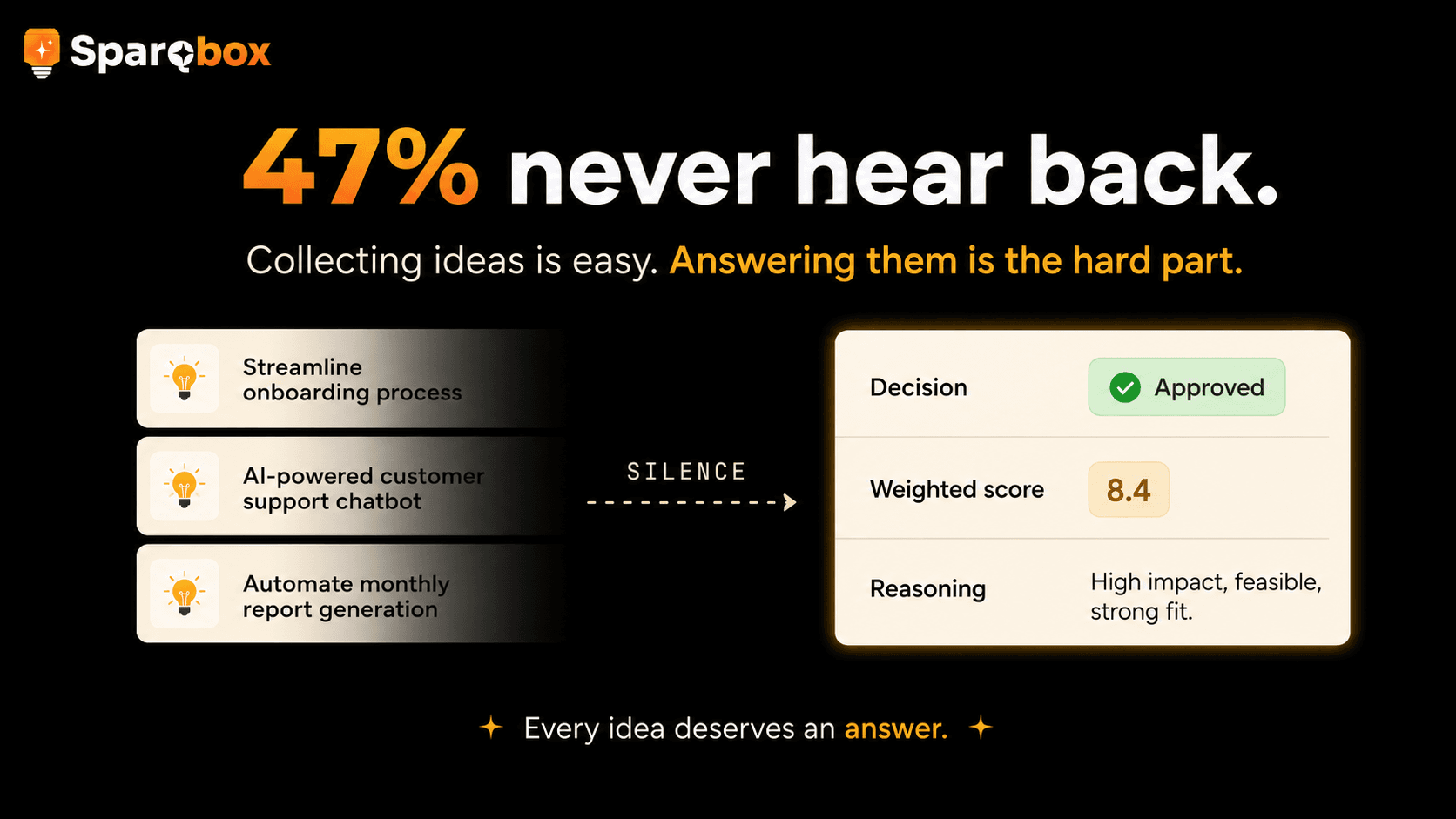
A clear no beats a polite silence in your suggestion box
Employees can live with a reasoned rejection. What they cannot live with is silence. Here is why a real no keeps people submitting, and how mandatory feedback and scoring thresholds make it routine.
By Dennis Jacobs
A clear no keeps people submitting. A polite silence is what makes them quit.
The claim
Most suggestion boxes do not fail because they reject too many ideas. They fail because they answer too few. An employee who submits an idea and hears a reasoned no will usually submit again. An employee who submits and hears nothing rarely comes back. The problem is not the decision. The problem is the absence of one. A vague "we will consider it" that never resolves is worse than a clean rejection with the reasoning attached, because it teaches people that submitting is a dead end. Sparqbox is built on the opposite assumption: every idea gets an answer, the answer arrives fast, and the answer carries the reasoning behind it. That is the whole design, not a feature bolted onto it.
Why this matters
Think about what actually happens to an idea in most companies. Someone notices a slow process, a wasted spend, a small fix that would save an hour a week. They write it down. They drop it in a form, an email, a channel, a physical box in the break room. Then the trail goes cold. No confirmation it was read. No timeline. No decision. Six weeks later they have forgotten they ever submitted it, and the quiet lesson has already landed: this is not worth the effort.
That lesson compounds. The first time someone hears nothing, they shrug. The second time, they hesitate before writing anything down. By the third silent cycle, the good ideas are staying in people's heads, discussed at the coffee machine and never captured. You do not see this as a dramatic failure. You see it as a suggestion box that "went quiet," a program that "lost momentum," an engagement number that drifts down a few points each quarter with no obvious cause.
The cost is not the rejected idea. Rejecting a weak idea is correct and healthy. The cost is the participation you lose from everyone watching how submissions get handled. People calibrate their effort to the response they expect. When the expected response is silence, effort drops to zero. When the expected response is a real answer, even an unwelcome one, effort holds. A rejection with reasoning says the system works and someone is paying attention. Silence says neither. That is why a clear no is an investment in the next submission, and a polite silence is a slow leak in the whole program.
There is a second cost that is easy to miss. Silence does not only stop the person who submitted. It spreads. The employee who never heard back tells a colleague not to bother. The manager who watched a dozen ideas evaporate stops encouraging their team to submit at all, because pointing people at a dead end feels worse than saying nothing. So the leak widens beyond the individual. A program that started with real enthusiasm settles into a handful of the same names submitting the same kind of idea, while the people closest to the actual work, the ones who see the small fixes first, have long since gone quiet. By the time leadership notices the numbers, the cause is a year of accumulated silence that no relaunch email will undo.
The polite version is the most dangerous version. A blunt suggestion box that visibly ignores everything at least sets honest expectations. A box that responds warmly and vaguely, that thanks people and promises consideration and then does nothing, trains people more slowly but just as completely. It buys a few extra cycles of goodwill before the same collapse. "We will consider it" is not a decision. It is a decision deferred until everyone forgets, which is the same as a no with none of the honesty and all of the erosion.
How Sparqbox handles it
Sparqbox removes silence as a possible outcome. There is no path through the product that ends in nothing. Every submitted idea gets a decision, and every decision reaches the submitter with the reasoning attached. The mechanics make that a default rather than a discipline someone has to remember to apply.
Here is how a submission moves. An employee submits an idea through a guided form into a strategic bucket, for example Process Improvement or Cost Reduction. Each bucket has its own set of criteria, and each criterion carries a weight. A criterion is a single scoring question, such as "Customer Needs" at a weight of 0.200 or "Effort to Implement" at a weight of 0.150. The weights are configured once per category and reflect what that category is actually optimizing for.
The AI first reviewer scores the idea before any human sees it. It reads the submission against each configured criterion and assigns a score, using the Claude API as a first pass. Then human reviewers score the same idea independently against the same criteria. The AI does not decide anything. It gives reviewers a consistent starting point and makes sure nothing sits unread while it waits for a free calendar slot.
The weighted score is deterministic math, not opinion. Each criterion score is multiplied by its weight, and the products are summed. The same inputs always produce the same number. That number drives the automatic decision against thresholds set per category: a weighted score at or above 3.5 approves, a score at or below 2.0 rejects, and anything in between lands in needs discussion, the middle state that routes an idea to a human conversation instead of a silent limbo.
That threshold structure is the part that kills silence. An idea cannot fall through a crack, because there is no crack. It either clears the approve line, falls below the reject line, or is explicitly flagged as needs discussion so a person picks it up. And whatever the outcome, the submitter hears back. The feedback step is mandatory, not optional. A rejected idea returns with the criteria it was scored against and where it fell short. An approved idea returns with what happens next. There is no "we will consider it" that quietly expires.
An admin can override an automatic decision when context outside the criteria matters, but the override requires a written justification. So even the exceptions are documented rather than silent. If a manager decides to approve something the math rejected, or reject something the math approved, the reasoning is written down and travels with the idea. That keeps the override honest and keeps the submitter informed, instead of leaving them to guess why the outcome does not match what the criteria would suggest.
Notifications go out by email, which is what the product supports today. The point is not the channel. The point is that a decision always leaves the building. Every submitter is on the receiving end of one, and the reasoning travels with it. The design goal was to make the answer the cheapest thing in the system to produce, so there is never a reason to skip it. When answering is automatic, the temptation to let an awkward idea sit unaddressed simply does not arise.
A real example
A warehouse associate submits an idea: move the label printer from the far end of the packing line to the middle so pickers stop walking the length of the floor for every order. It goes into the Process Improvement bucket.
The criteria for that bucket include Impact on Throughput at a weight of 0.250, Cost to Implement at 0.200, Effort to Implement at 0.150, and a few others. The AI first reviewer scores it, and flags high throughput impact with very low implementation cost, since moving a printer is close to free. Its weighted score lands around 3.8, above the approve threshold. The human reviewers score it independently and mostly agree, but one reviewer knows something the criteria do not capture: the middle of the line has a power and cabling constraint that makes that exact spot impractical. On the raw math the idea approves. In reality it needs a small adjustment first.
This is where needs discussion earns its place. Rather than approve an idea that cannot be executed as written, or reject a genuinely good one on a technicality, the reviewer moves it to needs discussion with a note. The associate hears back within days: the idea is strong, the throughput case is real, and the team is finding the right spot given the cabling. The reference number, something like IDEA-2026-0142, lets everyone track it.
Compare that to the silent version. In most suggestion boxes, that idea gets read, judged "probably not worth the wiring hassle," and quietly dropped. The associate never learns that the throughput logic was sound. They just learn that suggesting things goes nowhere. One good idea lost, and one fewer person willing to submit the next one.
Founder lens
My thesis at TU Eindhoven was on idea selection, and the finding that stuck with me was almost boring: the quality of a selection system matters less than whether people trust it enough to keep feeding it. A brilliant scoring model with no feedback loop starves itself. People stop submitting, and there is nothing left to score.
So when I built Sparqbox, I made feedback mandatory before I made anything else clever. It would have been easier to ship the scoring engine and treat notifications as a nice-to-have. I did not, because I have watched too many suggestion boxes die of silence rather than of bad decisions. A no with reasons keeps the door open. A shrug closes it. I would rather deliver an honest rejection today than a polite maybe that quietly becomes a no in six weeks without anyone saying so.
Takeaway
- Treat silence as the failure mode, not rejection. A reasoned no protects participation. An unanswered idea erodes it.
- Make feedback mandatory, not a good intention. If any idea can end in nothing, some always will.
- Give the reasoning, not just the verdict. "Rejected against these criteria, here is where it fell short" keeps trust that a bare no does not.
- Build a middle state. Needs discussion catches the ideas that are neither clear approvals nor clear rejections, so they get a person instead of a void.
- Answer fast. A quick no beats a slow one, and both beat silence.
Every idea deserves an answer. The rejection is not the risk. The silence is.