Separating the wheat from the chaff.
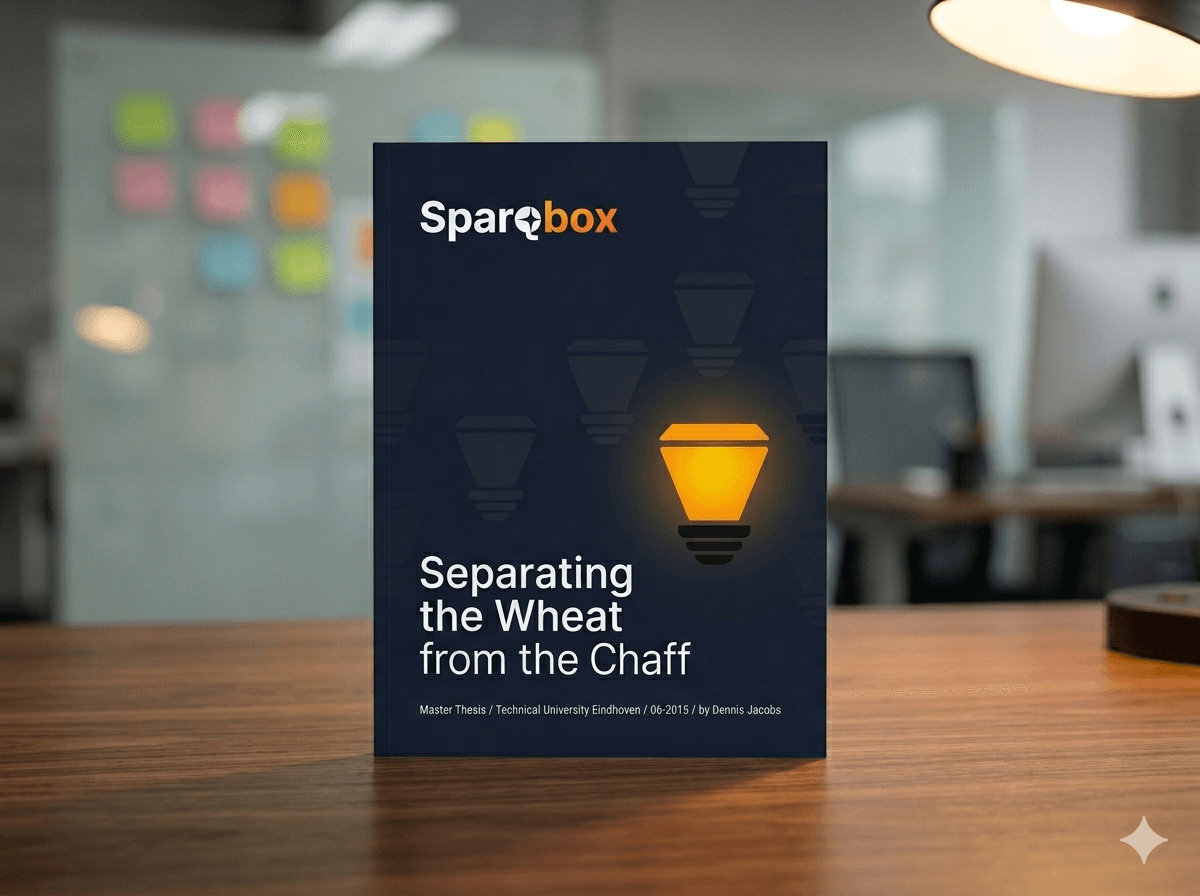
Sparqbox is the operationalisation of a 2015 Master's thesis at TU Eindhoven that benchmarked how 48 companies actually select ideas at the front end of innovation, with a deep case study at Rockfon. The conclusion was uncomfortable: most companies don't have a real selection process, and the ones that do get the order wrong.
MSc thesis · Innovation Management · TU Eindhoven · 2015 · Supervised by Dr. T. Treffers and Prof. dr. F. Langerak
companies benchmarked across automotive, electronics, building materials and consultancy
in-depth interviews at Rockfon (Rockwool International subsidiary)
selection criteria analysed and selection methods compared head-to-head
Three methods, one question.
Note on the headline number: the questionnaire was distributed to 50 companies; 48 returned a valid response and form the dataset. Both figures appear across this page and in the research summary. The site-wide rounding to 50 reflects the questionnaire reach; the academic respondent count is 48.
Method 1
Literature review
Synthesised academic research on the front end of innovation. Anchored on the Innovation Funnel (Russell & Tippett, 2008) and the New Concept Development model (Koen et al., 2002). Mapped which selection criteria and methods the field said should work.
Method 2
Case study at Rockfon
15 semi-structured interviews across innovation managers, R&D leads, and the people actually submitting ideas at Rockfon (an 800+ employee subsidiary of Rockwool International). Analysed evaluation forms, meeting records, and decision documentation to map the existing process and its breakdowns.
Method 3
Benchmark across 48 companies
Surveyed 48 companies across industries about their idea selection practices. Identified the top 25% on innovation success factors and compared their methods, criteria weights, and decision-making against the rest. The differences were statistically significant.
Five things the research established.
Six criteria, but the weighting is the story
The benchmark surfaced six universal criteria: customer acceptance, strategic fit, marketing, competitive, financial, and technical feasibility. The top 25% of companies weighted them very differently from the rest: high on customer acceptance and strategic fit, low on financial and technical feasibility. Average performers had it almost the opposite way.
Strategic buckets + scoring models won
Five common selection methods were compared head-to-head. Strategic buckets (categorising ideas by innovation type, each with its own resources and criteria) and weighted scoring models scored highest among best-practice companies on every measure. Financial methods (ROI, NPV, payback) scored lowest.
Financial criteria belong last, not first
The most counter-intuitive finding: companies that lead with financial projections in the early stage perform worse than those that don't. Early-stage financial data is unreliable and hard to compare across ideas. Leading with it kills good ideas before they have data and lets bad ones survive on optimistic spreadsheets.
Order matters more than which criteria you pick
The case study found a clear sequence among effective evaluators: gut feeling first (a checklist that forces articulation without demanding data), then customer + strategic + market criteria (the scoring model phase), then technical feasibility and financial viability last. The order is the system.
Every idea needs a real response
Companies where rejected ideas got no explanation saw submission rates collapse. Submitters stop contributing not because their idea was rejected but because they were ignored. The mandatory feedback loop is the single most underrated mechanism in the research.
“There should be a procedure so that it is known why ideas are killed.”
Interview respondent · Rockfon case study, 2015
A three-phase process for idea selection.
Combining the literature, the case study, and the benchmark, the thesis proposed a three-phase selection process. Each phase has its own method, criteria, and outcome, and the order is non-negotiable. This is the process Sparqbox implements, end-to-end.
1. Pre-selection
2. Idea evaluation
3. Feasibility check
Six conclusions.
01
Structure beats intuition, but intuition has its place.
The best process starts with gut feeling and progressively adds rigor.
02
Strategic buckets + scoring models produce the best outcomes.
They align innovation with strategy and remove bias from prioritisation.
03
Financial and technical criteria belong last, not first.
Over-relying on financial projections in early stages actively harms innovation performance.
04
One person should own the process.
Multiple gatekeepers create miscommunication and inconsistency.
05
Every idea deserves feedback.
Rejected ideas without explanation discourage future contributions.
06
The process must be flexible.
Different categories need different criteria weights, and the system must evolve as strategy changes.

Sparqbox is the operationalisation.
Strategic buckets become configurable categories, each with its own weighted scoring criteria. Scoring models become interactive scorecards. Weighted criteria are configured per category. Priority lists are generated automatically. The Innovation Manager becomes the admin role. Cross-functional evaluation is enabled through multiple reviewer assignments. Mandatory feedback to every submitter is enforced by the system. AI extends the model with an independent first review. Every product decision traces back to a finding from the thesis.
Read the full research, free.
A 14-page summary of the thesis: methodology, findings, the three-phase process, real quotes from the case study, and how Sparqbox implements each finding. No email gate, no sales call. The research speaks for itself.
Sparqbox Research Paper
PDF · 170 KB · 14 pages · English. The full thesis manuscript is available on request. Email Dennis directly.
Every idea deserves an answer.
Give your team the one thing a suggestion box never will: a real decision, every time.