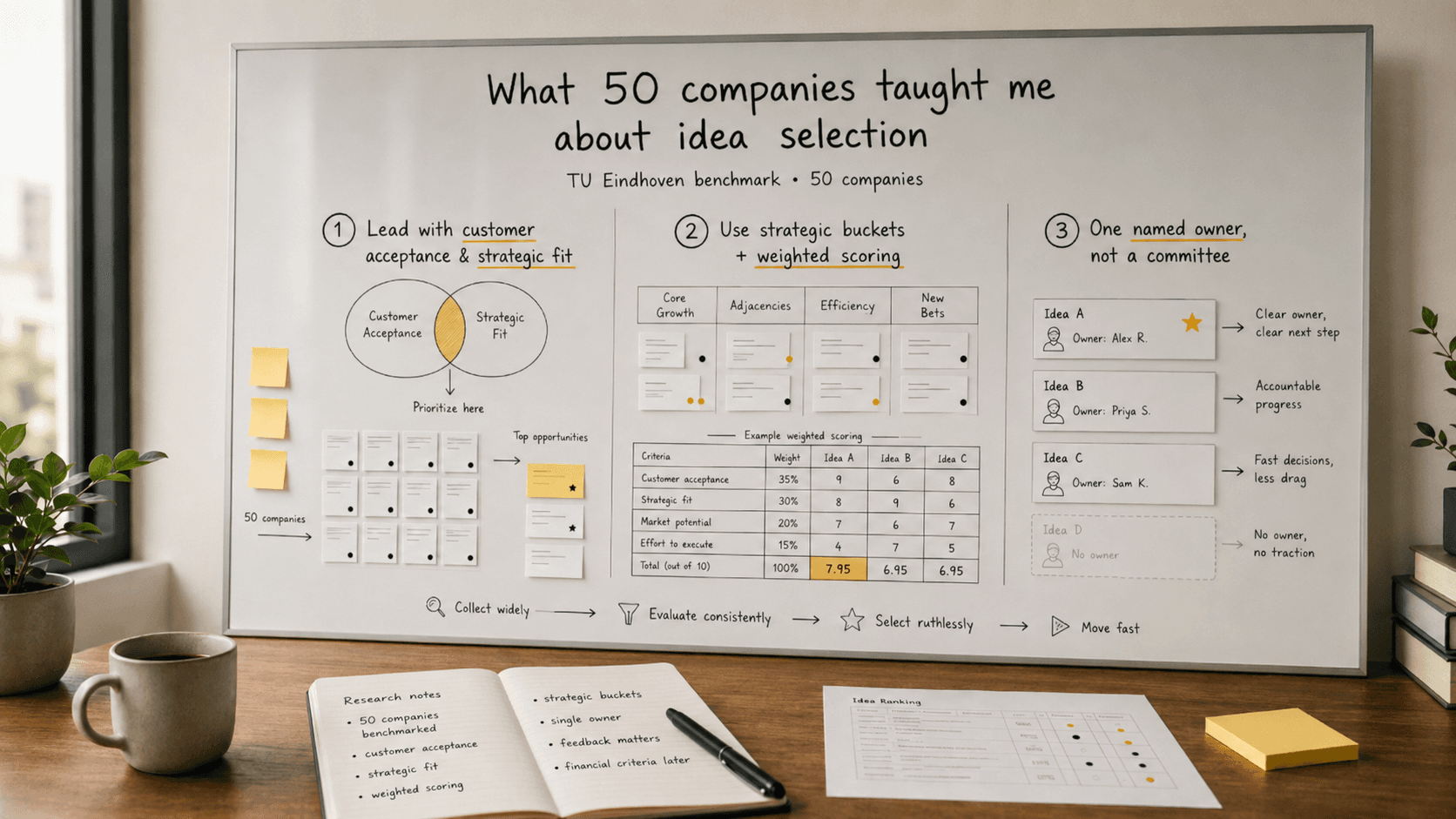
What 50 companies taught me about idea selection
This blog explains that Dennis’ TU/e benchmark of 50 companies found that strong idea selection does not start with financial models or technical feasibility, because those numbers are usually unreliable in the early stage. The best-performing companies used strategic buckets, weighted scoring, customer acceptance, strategic fit, and one clear process owner instead of letting ideas drift into committees or management meetings. The main lesson: innovation programs work when every idea has a clear route, fair criteria, a named owner, and a guaranteed response, which is the research foundation behind Sparqbox.
By Dennis Jacobs
What 50 companies taught me about idea selection
In 2015, Sparqbox's founder Dennis Jacobs benchmarked 50 companies for his TU Eindhoven master's thesis on idea selection in the front-end of innovation. The best-performing programs broke three rules that most companies still follow. They used financial and technical criteria less than average companies, not more. They led with customer acceptance and strategic fit. And they handed routine decisions to a single named owner backed by a cross-functional committee, not to the management team.
The thesis was published more than ten years ago. The findings hold today. If anything, they have become more useful as the number of "innovation management" tools has multiplied without changing the underlying problem they claim to solve. Most software in the category encodes the rules the research disproved. This article walks through the three findings, why they matter, and what they imply for SMB innovation programs in 2026.
How the research was done
The study combined two methods. A case study at Rockfon, an industrial company struggling with an unstructured idea selection process, established what a poorly-performing program looks like from the inside through fifteen semi-structured interviews and secondary data analysis. A benchmark questionnaire sent to 50 companies across automotive, electronics, building materials, and consultancy industries established what high-performing programs do differently.
Best-practice companies were defined as the top 25 percent of respondents by self-reported scores on the six success factors of idea selection identified by Cooper, Edgett, and Kleinschmidt in their 2001 industry practices study. Twelve of the 48 valid respondents qualified. The questionnaire measured which selection criteria and selection methods each company used, on five-point Likert scales. Independent-samples t-tests then identified which practices significantly differed between best-practice companies and the other 75 percent.
The differences were not subtle. They contradicted what most companies, then and now, believed about how good idea selection works.
Finding 1: The criteria most companies trust most are the ones that hurt their pipeline
When companies are asked which criteria they use to evaluate new ideas, the most common answers are financial criteria (return on investment, projected revenue, payback period) and technical feasibility (can we build it, do we have the capability). These feel like the responsible criteria. They produce numbers. Numbers feel like decisions.
The benchmark showed the opposite. Best-practice companies used technical feasibility significantly less than average companies (t(46)=2.525, p=0.015). They used financial criteria significantly less (t(46)=2.086, p=0.043). They used strategic fit significantly more (t(46)=-2.483, p=0.017), marketing criteria significantly more (t(46)=-2.222, p=0.031), customer acceptance significantly more (t(46)=-2.380, p=0.022), and intuition-based "other" criteria like gut feeling and probability of success significantly more (t(46)=-2.455, p=0.018).
In plain language: the companies running the best idea selection programs were not the ones with the most rigorous financial models. They were the ones that knew financial models could not be trusted in the front-end of innovation, because the data needed to calculate them did not yet exist. So they front-loaded the cheap, judgment-heavy criteria (does the customer want this, does it fit our strategy, is it differentiated from competitors) and saved the expensive analyses for the small number of ideas that survived the first cut.
This matches an earlier finding in the literature. In their 2001 industry practices study, Cooper, Edgett, and Kleinschmidt scored selection methods against the six success factors of idea selection and found that companies relying on financial methods scored worst on four of the six factors. Strategic buckets and scoring models scored highest.
The order of criteria matters more than the criteria themselves. The right sequence in the front-end is gut feeling first (used for cheap triage of obviously-bad ideas), then customer acceptance, marketing, strategic fit, and competitive criteria (used to evaluate viable candidates), then financial and technical feasibility (used as the final filter before committing real resources). Most companies still apply the same sequence backwards.
Finding 2: The methods that win are the unfashionable ones
The benchmark tested five selection methods used in the front-end: financial methods, strategic buckets, bubble diagrams, scoring models, and checklists. Best-practice companies showed a clear pattern. They used financial methods significantly less (t(46)=2.613, p=0.012). They used strategic buckets significantly more (t(46)=-2.847, p=0.007). They used scoring models significantly more (t(46)=-2.445, p=0.018). Bubble diagrams and checklists showed no statistically significant difference between groups.
Strategic buckets is the practice of grouping ideas into categories that each have their own pool of resources, set by the company's innovation strategy. Each bucket has its own scoring criteria with weights tuned to what success looks like in that category. A "process improvement" bucket and a "new product" bucket get different criteria, different weights, and different resource allocations, because the same idea would not succeed in both.
Scoring models is the practice of evaluating each idea against weighted criteria on a Likert scale, summing the weighted scores, and ranking the results. The benefit is that qualitative and quantitative judgments combine into a single comparable number. The weakness, as the literature acknowledges, is that the weights themselves are subjective. The fix is to set weights at the strategic level before any ideas are scored, by people who do not yet know what the ideas will be, so that the criteria cannot be rigged for a favored proposal.
The two methods work best as a pair. Strategic buckets sets the resource allocation across categories. Scoring models ranks the ideas within each bucket. This is the architecture the thesis recommended for Rockfon, and the architecture Sparqbox uses today.
Financial methods scored lowest in the benchmark for the same reason they scored lowest in the Cooper et al. study: the data is not available in the front-end. Using a method that depends on data you do not have is worse than using a method that openly acknowledges judgment, because the false precision of a financial model is harder to argue with than an explicit Likert score, even when the underlying numbers are guesses.
Finding 3: A single named owner beats a committee
The case study at Rockfon found that the company's idea selection process had multiple people responsible for different parts of it. Different employees gave different answers about who was in charge. Submitted ideas reached different recipients depending on which manager the submitter happened to know. Some ideas were evaluated by a product manager, some by a development manager, some directly by the management team. The same idea could receive different decisions depending on who picked it up.
This was not a Rockfon problem. It was a structural problem the thesis found across most underperforming programs. The fix, recommended in the redesign and supported by the benchmark, was a single named owner of the front-end process. The thesis called this role the Innovation Manager. The title varies in practice (innovation lead, idea coordinator, process owner) but the function is the same: one person owns the pipeline from submission to decision, with the authority to route ideas, initiate scoring, and escalate when needed.
The Innovation Manager does not decide alone. They work with an Innovation Committee, a cross-functional group of representatives from product, marketing, sales, technical, and communications. The committee scores ideas against the configured criteria. The Innovation Manager runs the process and ensures every idea gets a decision. Only ideas that require significant capital allocation escalate to the management team. Everything else gets decided at the committee level, on a fixed cadence, with no agenda pressure from unrelated topics.
This structure addresses the failure mode the case study found at the management team meeting: ideas were scored on "impact and success" alone, on a flipchart, by people with no time to think carefully about them. Routine decisions belong at a lower level with named authority. The management team's time should be reserved for the small number of decisions only they can make.
The benchmark backed up the recommendation. Best-practice companies were significantly more likely to have an R&D team and senior management as their stated decision-makers, but the decisions were structured: R&D teams handled routine evaluation, senior management ratified the few high-stakes calls.
The three-phase process the research recommends
The redesign that came out of the thesis is a three-phase process. Phase 1, pre-selection, is a short checklist filled out by the submitter, then sent to regional or functional representatives for a gut-feel response. If half or more of the recipients support the idea, it moves to Phase 2.
Phase 2, idea evaluation, places each idea in a strategic bucket and scores it against the bucket's weighted criteria. The Innovation Committee handles the scoring, drawing on lead customers and subject-matter experts for input. The criteria are the four the benchmark identified as most predictive of success: customer acceptance, marketing, strategic fit, and competitive criteria. The output of Phase 2 is a priority list of ranked ideas per bucket.
Phase 3, feasibility check, applies the financial and technical criteria the benchmark said belonged last. Not as full business cases (that work happens in the next stage of the broader stage-gate process) but as a simple Likert-scale assessment of whether the idea is plausibly buildable and whether the economics are not catastrophically broken. The output is a one-page concept document that the Innovation Committee uses to decide which ideas leave the front-end and enter formal development.
The three phases together do not eliminate judgment. They locate it. Gut feeling earns its place at the start, where it is cheap and useful. Customer and strategic judgment lives in the middle, where it is the best signal available. Financial discipline arrives last, when there is enough information to apply it. The order matches what the research found high-performing companies actually do, and what most underperforming companies still get backwards.
What this means for SMBs in 2026
The 50-company benchmark was conducted with industrial companies in 2015. The pattern has held in the decade since, across the dozens of organizations Dennis has observed directly. If anything, the findings have become more applicable to mid-sized companies (50 to 500 employees) than to the large industrials they were originally measured on.
Two reasons. First, smaller companies cannot afford the false confidence of financial models in the front-end. A 200-person SMB does not have the slack to discover, twelve months in, that the projected return on a project was built on guesses. Front-loading the cheap criteria is not a methodological preference for SMBs. It is a survival instinct.
Second, smaller companies live or die on the strength of their pipeline. A larger company can absorb a thin year of innovation through scale. An SMB cannot. Programs that survive the first year are the ones that give employees clear answers, finish what they start, and build trust between submitters and decision-makers. The benchmark named that trust signal directly: the single most predictive variable for program survival was the presence of structured feedback to every submitter, regardless of the outcome.
That commitment is what "Every idea deserves an answer" means in the Sparqbox tagline. It is not aspirational. It is the operational variable the research identified as most important. The mechanics of how programs fail at the front end (covered in the five moments where ideas die) and the argument for why feedback is non-negotiable (in why every employee idea deserves an answer) both trace back to the same finding from this research.
Common questions
Why are financial criteria a bad fit for early-stage idea selection?
Because the data needed to calculate them does not yet exist. Return on investment, payback period, and net present value all depend on numbers about the future that are still guesses in the front-end. Applying a method that requires precise inputs to fuzzy data produces precise-looking outputs that are no more reliable than the underlying guesses, and harder to argue with than an explicit Likert score.
Which criteria should you use first when evaluating an idea?
Gut feeling is the right first criterion. Not as the final answer, but as cheap triage to filter out obviously-bad ideas before applying more expensive evaluation. After gut feeling, the criteria that should drive the middle of the evaluation are customer acceptance, marketing fit, strategic fit, and competitive differentiation. Financial and technical feasibility belong at the end, when there is enough information to apply them honestly.
What is the strategic buckets method?
Strategic buckets is the practice of grouping new ideas into categories aligned with the company's innovation strategy, where each category has its own allocated resources and its own weighted scoring criteria. Ideas within a bucket compete against each other, not against ideas from other buckets. This forces a company to allocate innovation effort against strategic priorities instead of against the loudest proposal.
Should the management team decide which ideas to pursue?
Not for routine decisions. The research recommends a single named owner of the front-end process (the Innovation Manager) backed by a cross-functional Innovation Committee that handles weighted scoring. The management team should only decide on ideas requiring significant capital allocation. Routine evaluation at the management team level is the failure mode the thesis found in most underperforming programs.
Does this apply to companies smaller than 200 employees?
Yes. The pattern is more important for smaller companies, not less. Mid-sized SMBs (50 to 500 employees) cannot absorb the cost of running idea programs that produce false confidence and unfinished commitments. The structural variables the research identified (single ownership, structured criteria, mandatory feedback) are easier to implement at SMB scale than at large industrial scale, and produce more value relative to the cost.
The takeaway
The 50-company benchmark established three things about how good idea selection actually works. Front-load the cheap criteria. Use strategic buckets and scoring models, not financial-first ranking. And give one named person ownership of the process, supported by a committee, with the management team escalated to only when it is genuinely required.
Sparqbox is the architecture those findings imply, built as software. The categories are strategic buckets. The criteria are weighted on a 1.000 sum. The scoring runs through a deterministic engine that the AI first reviewer feeds but does not control. The Innovation Manager is a named role in the product. Every idea gets a decision before it closes.
The research is older than the software. The software exists because the research keeps being right.